In this discussion, our average reader interested in finance will be able to connect the business of highly traded companies at the Pakistan Stock Exchange (PSX) (like EFERT and FFBL) to the theoretical and practical realities of soil science.
Fertilizers in Pakistan and their Impact on Agricultural Productivity
Macronutrients and Micronutrients
Every crop needs macronutrients and micronutrients to grow. The primary macronutrients have their individual importance in simple terms:-
Nitrogen (N): Vegetative growth
Phosphorous (P): Flowering, fruit and root growth
Potassium (K): Overall health and growth.
Furthermore, there are three secondary macronutrients needed for growth:
Sulphur (S): Chlorophyll production, seed formation and plant hardiness
Calcium (Ca): Cell wall formation and resistance to disease and environmental stress
Magnesium (Mg): Chlorophyll production for healthy leaf tissue
Lastly, there are various micronutrients also required by the plant. The deficiencies most studied and highlighted in Pakistan are Zinc and Boron deficiencies. However, deficiencies of other micronutrients such as iron, copper, manganese, and molybdenum also exist.
Fertilizers in Pakistan
Fertilizers are inputs purchased by farmers to add nutrition or change properties of the soil. If you come across a fertilizer bag, the most visible thing on the bag after the brand name is ‘three numbers’.
These three numbers refer to the ratio of the three primary macronutrients, N – P – K, in the bag. For example, 18:46:0 is the formula for Di-Ammonium Phosphate (DAP), the second most common fertilizer used in Pakistan. This means that it contains 18% N, 46% P, and 0% K (Potassium colloquially referred to as Potash), measured by the composition of the forms that are uptakeable by the plant: Phosphorous pentoxide (P2O5) for P and Potassium Oxide (K2O) for K.
In Pakistan, farmers predominantly use Urea (46:0:0) and DAP (18:46:0). There is general under application of Potash (K) fertilizers leading to crop yields far lower than the potential.
Discussion of nutrients required by crops, usage of fertilizers in Pakistan and their impact of agricultural productivity.
Relative usage of NPK fertilizers in Punjab by district
District and Nutrient-wise Fertilizer Offtake and Use during 2022-23 (tonnes)
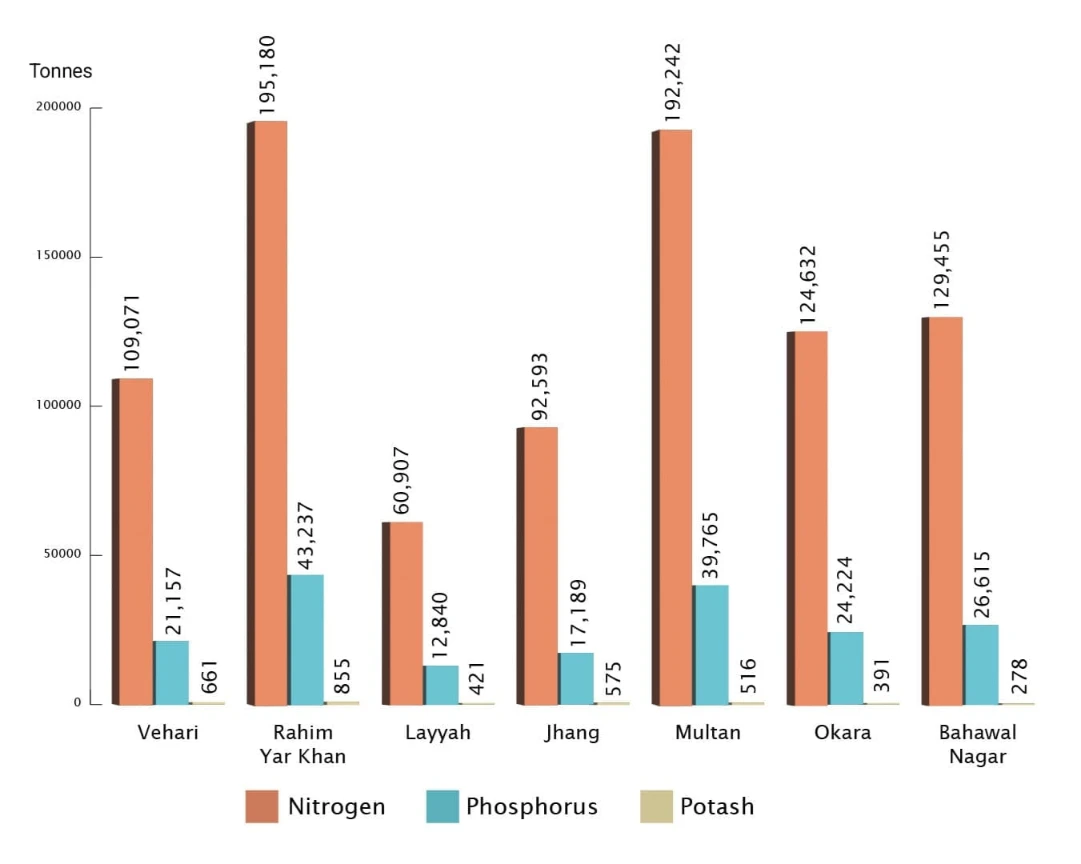
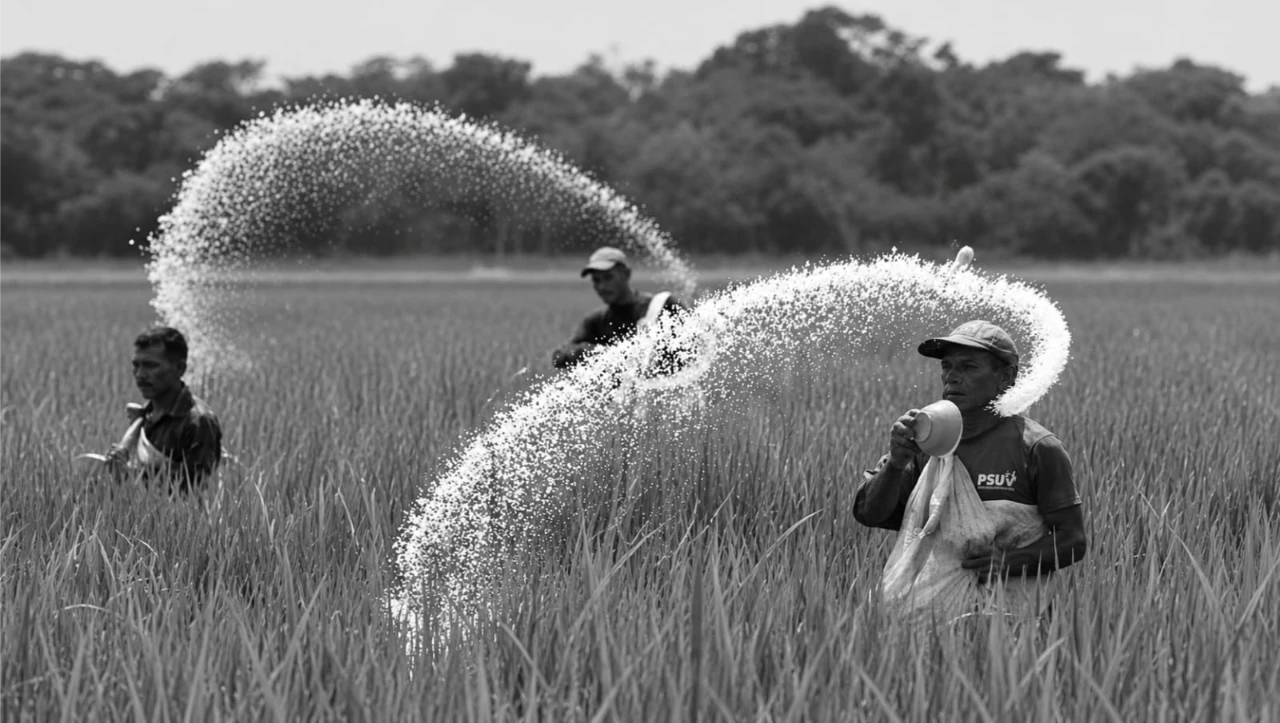
While all farmers invariably use Nitrogen and Phosphorous, Potash usage is negligible.
The Nitrogen (N) in Urea and DAP is provided by ammonia, a raw material derived from natural gas. Since natural gas is readily available from our indigenous deposits in Sui, connections to large fertilizer companies have historically been provided at a subsidized rate, though this arrangement has narrowed in recent years as feedstock tariffs for plants on the SNGPL network have been raised toward RLNG-equivalent levels, leaving only plants on the Mari network with cheaper indigenous gas. The fertilizer sector remains one of the largest consumers of Pakistan’s natural gas, accounting for roughly a quarter of total supply.
Agronomic Subtleties
Before discussing fertilizers in Pakistan in more detail, it is important to first explore soil nutrition. There is no available data (for public) on nutrient deficiencies in the country. Based on dated estimates from the FAO, almost all our soils are naturally Nitrogen deficient, more than 9% of soils have inadequate soil Phosphorus and up to 40% of soils are deficient in Potash.
With respect to secondary macronutrients, it is a common myth that calcium and magnesium deficiencies do not exist in Pakistan. While calcium and magnesium are present in large amounts, they exist in the form of calcium carbonates and magnesium carbonates that are not readily uptakeable by crops.
The average farmer may not even know that Urea is a source of Nitrogen or DAP is a source of Phosphorus. They purchase inputs pushed by their Aarti – informal agents who purchase a farmer’s harvest and give inputs on credit against it. Frequently, these inputs are traditional N-P fertilizers such as Urea and DAP.
The informed farmer looks at the analysis of the product, which refers to its nutrient composition and tries to place a value on it. Certain products have elements that are not readily uptakeable by the plant, while others have high salt content that is toxic to some crops like tobacco. There are many factors to consider and without the requisite knowledge, average farmers invariably have lower yields.
Sources of Fertilizer Material
We discussed earlier how Urea and DAP use indigenous natural gas to produce nitrogenous fertilizers. Urea is usually not allowed or feasible to import into the country. The Economic Coordination Committee (ECC) of the Federal Cabinet decides import of Urea during shortages, and continues to periodically weigh in on gas allocation to individual urea plants to head off shortfalls ahead of each Rabi and Kharif season. Another fertilizer that uses gas in Pakistan is Calcium Ammonium Nitrate. Due to Ammonium Nitrate’s use as a potential explosive, it is not easily available in some areas of the country such as KPK.
Although we have local phosphate deposits such as the famous Hazara Phosphate, phosphate rock does not make for a good fertilizer. For it to be effective, it requires being converted into phosphoric acid. As a result, the only major producer of DAP, Fauji Fertilizer Bin Qasim (FFBL), sources its phosphorus from its joint venture with the OCP group in Morocco. A large amount of DAP is imported into the country to meet Pakistan’s requirements, and DAP prices have remained far more volatile than Urea in recent seasons given this import dependence.
Potash fertilizers such as Muriate of Potash (MOP) and Sulphate of Potash (SOP) remain largely import-dependent, as we do not have any potash deposits. SOP can be produced from MOP using the Mannheim process, and a growing number of domestic producers have added Mannheim-process SOP capacity, reducing the country’s reliance on finished SOP imports even as it raises demand for imported MOP as feedstock. MOP is now imported chiefly from Canada, which has overtaken traditional suppliers such as Belarus and Jordan. Both MOP and SOP can also be combined with NP fertilizers to make NPK blends.
This shift is worth sitting with. Domestic SOP capacity has gone from negligible to around 110,000 tonnes a year in the space of a couple of years, as producers like Barket Fertilizers and Suncrop built out Mannheim plants. SOP arrivals fell sharply through 2025 as a result. None of this changes Pakistan’s underlying potash deficiency, since the raw material still comes in from abroad. But it does mean the “Potash is entirely imported” line from a few years ago no longer holds cleanly, and it is a rare case in this sector of local manufacturing capacity actually expanding rather than shrinking under gas curtailment.
Nutrient Wise Offtake
It is easy to observe that our Potash offtake is far below our N and P offtake, making Pakistan lose on potential crop output. In regional terms, India consumes approximately 4 million tonnes of Potash, roughly 40 times the amount consumed by Pakistan. Adjusted for population, India consumes almost ten times more than the country.
There are three main reasons for this under application:
- Potash is usually the ‘third bag’ and left out in the absence of input finances
- Rising input costs since imported Potash is linked to rupee devaluation
- Lack of awareness on Potash and crop NPK requirements
Potential for Yield Increases
We have already started discussing the under application of Potash (K). But what exactly is the value proposition it offers to the farmer if they decide to hypothetically spend on the ‘third bag’.
A study conducted across Sindh and Punjab in 2015, found that the use of potassium and micronutrients, alone or with farmyard manure, in addition to the typical NP fertilizers, improved crop yields. Yields for sugarcane increased by over 60% in some cases when NPK fertilizers, micronutrients and manure were used as compared to when just Urea (N). Lack of proper fertilization partly explains why crop yields in Pakistan have consistently lagged other countries.
Sugarcane yield in Sindh and Punjab by nutrients provided (maunds/acre)
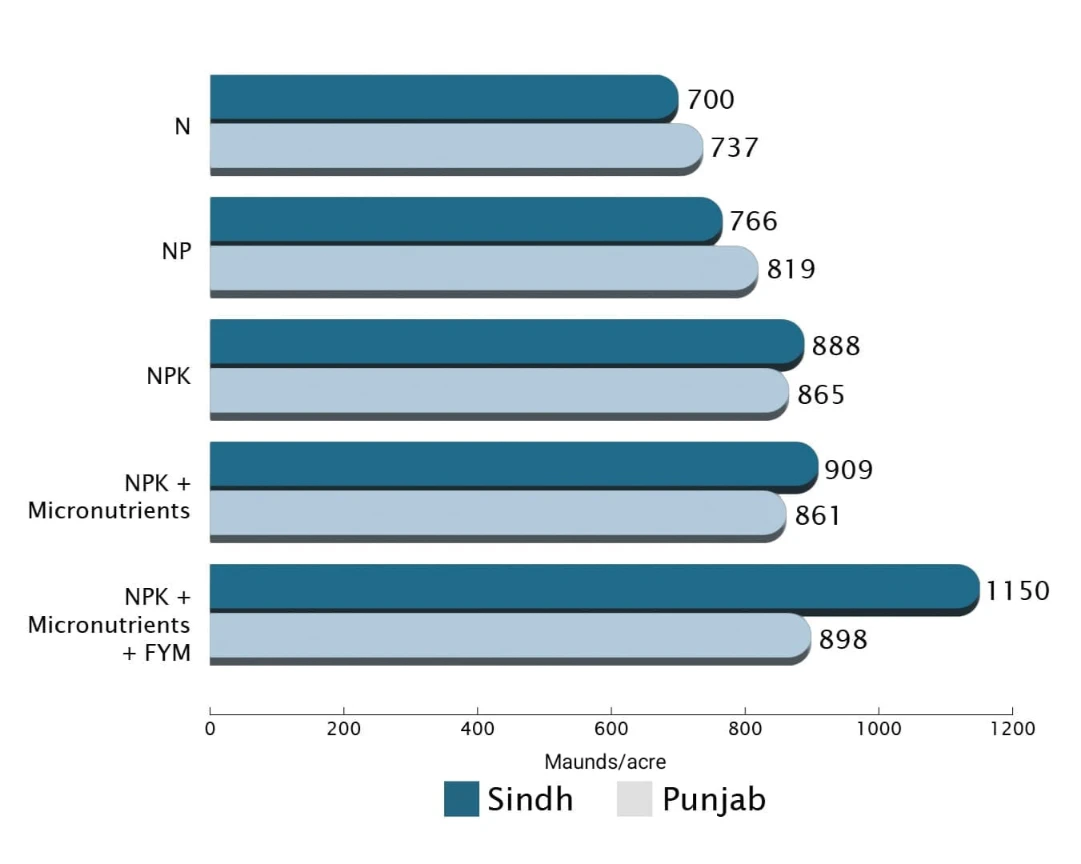
Use of potash along with other nutrients achieves optimal crop productivity.
Usually, aside from improvements in the quality of produce, the increase in yield usually offsets the initial cost of investment if Potash (K) is applied. This is calculated by the Value Cost Ratio (VCR) of a fertilizer. This is not restricted to macronutrients. Studies by the Pakistan Agriculture Research Council (PARC) have shown that micronutrients such as Zinc and Boron can give a VCR of 10:1 to 25:1, showing incredible promise.
Nitrogen Use Efficiency (NUE)
Nitrogen Use Efficiency (NUE) is the fraction of applied nitrogen that is absorbed and used by the plant. Despite having one of the highest per-hectare applications of nitrogen, Pakistan has one of the lowest NUE ratios and average yields globally.
Excess Fertilizer Usage (kg/hectare), Wheat Yield (kg/hectare) and Nitrogen Use Efficiency (NUE) for Cotton crop across countries
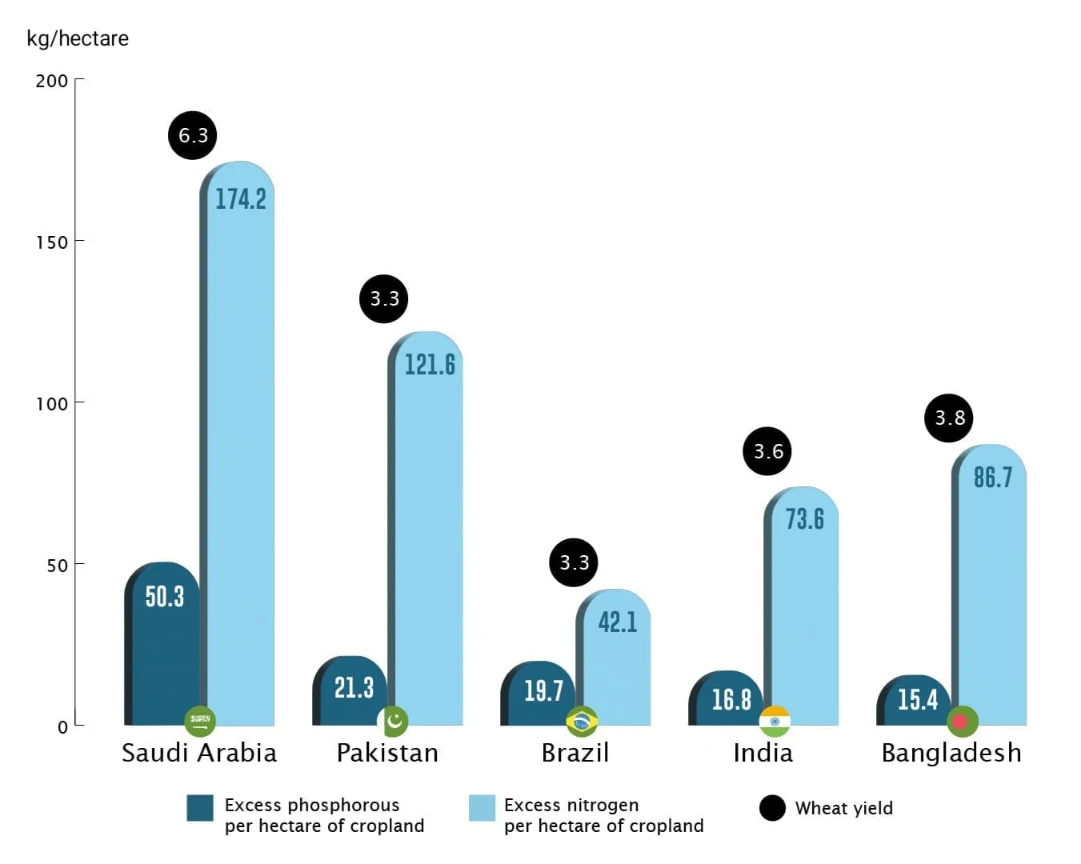
Pakistan uses the highest amount of nitrogen with the least efficiency in cotton crops.
Pakistan applies more nitrogen per hectare to cotton than the countries in the comparison, yet records one of the lowest levels of nitrogen use efficiency (NUE), meaning a large share of fertilizer is not converted into crop growth. Low urea prices encourage excessive nitrogen application because it produces rapid visible greening, leading many farmers to equate lush foliage with higher productivity even when yields do not improve. This imbalance is compounded by poor nutrient management, resulting in excess nitrogen and phosphorus accumulating on cropland while wheat yields remain below those of many peer countries. Together, these patterns suggest that improving fertilizer efficiency and adopting balanced nutrient application could raise productivity while reducing input costs and environmental damage.
Government Policy: Beyond the Urea & DAP Paradigm
Forward thinking governance would immediately recognize that poor yields correlate with poor NUE. Conventional fertilization traditions in Pakistan hinder farmer’s financial prosperity in the short term and threaten food security in the long term. This would require resisting lobbying from rent seeking corporates that depend on gas rate concessions. A national alignment with global movements towards sustainability and nutrient management can easily ensue. A part of efficient use of fertilizers in Pakistan includes balanced fertilization including Potash (K) use.
Potash consumption directly benefits from microfinance schemes that finance inputs, allowing them to invest in the ‘third bag’ after their N & P fertilizers. A straightforward way to increase potash consumption would be to provide a subsidy to the farmer. This can be through supply side exemptions of taxes, levies and import finance. Cash reimbursements such as the Punjab Potash Fertilizer Subsidy, which has offered farmers a discount per bag on NPK, SOP and MOP purchases, are also possible. Due to poor financial literacy, many farmers have been unable to avail such schemes.
However, subsidies are usually an unimaginative way to deal with problems that require sustainable solutions. The government can promote slow release fertilizers so that nitrogen is supplied throughout the crop cycle. The Indian government scheme to compel domestic producers of Urea to coat their product with Neem Oil is an example.
Policy focus should go from increasing fertilizer use volume to efficient nutrient management. Simple examples are:
- Promote compound NPK fertilizers that contain N in proper ratios.
- Awareness of growing legumes in crop rotations that fix atmospheric nitrogen.
- Promote use of biofertilizers that contain microbes that help uptake nutrients.
- Introducing Urease Inhibitors to slow nitrogen cycle, increasing available N.
Private Sector Participation
Most of our discussion has been focused on recommendations for government policy and awareness campaigns. However, most fertilizers are marketed and distributed by the private sector. The government should ease the interaction between progressive farmers and innovative agriculture firms. It can provide cheap and readily accessible testing facilities so farmers can analyze and verify new products easily. This would remove the default suspicion of milawat (adulteration) that precedes interaction between parties.
Within the private sector itself, improvements in distribution will inevitably emerge by themselves. Taking advantage of Pakistan’s high mobile penetration and mobile wallet use, future e-commerce platforms can provide access to a larger product range including innovative fertilizers.
Original Author, ‘Umer Vakil’, analysis from the archive of Macro Pakistani.
Updated in 2026 by Macro Pakistani’s Head of Content Research, Sharmeen Sajjad.