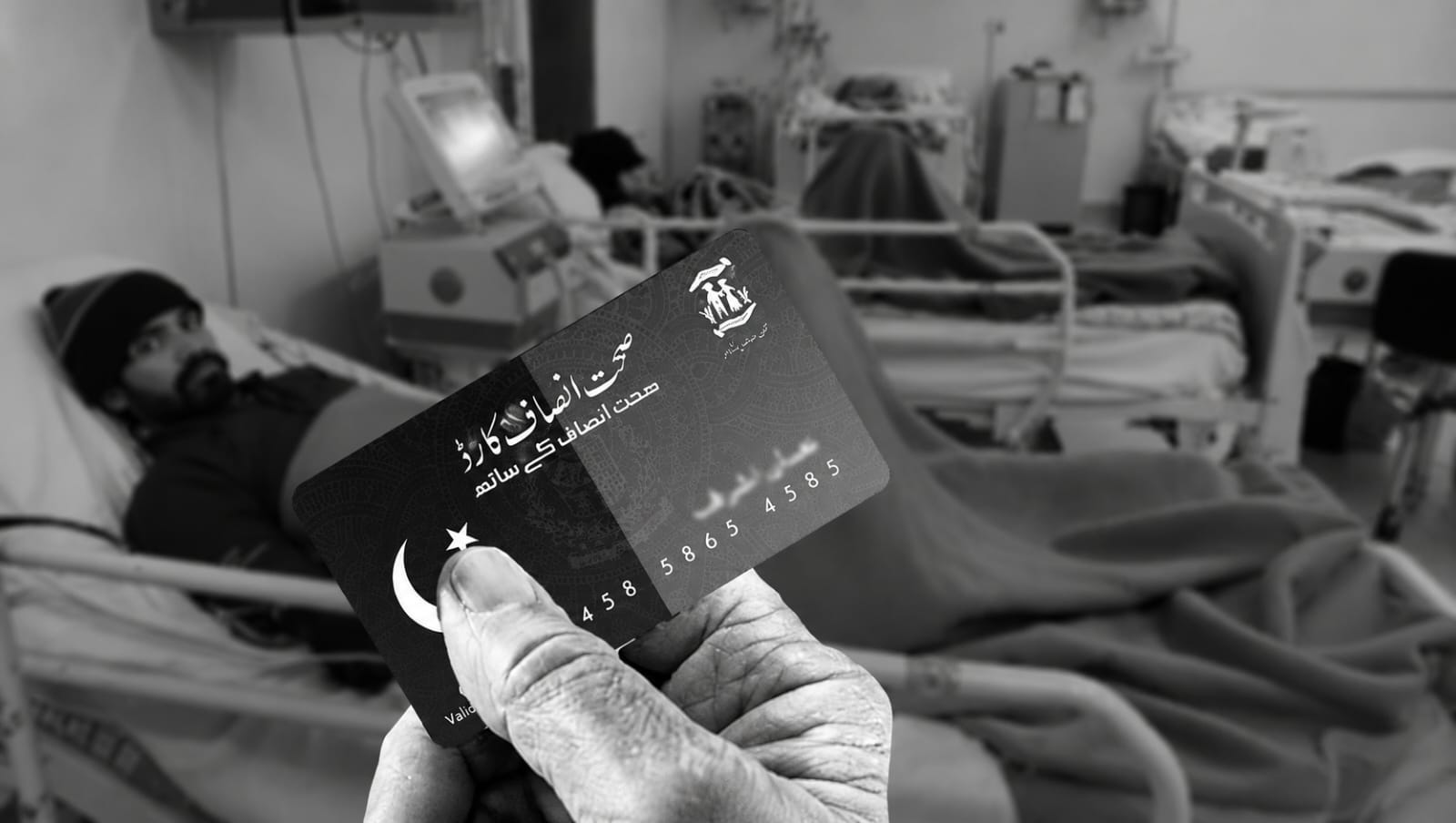
Short answer: Sehat Sahulat has helped move Pakistan closer to that goal, but there is still a long way to go, and the path has gotten more uneven as the programme has split apart by province.
Editor’s Note: Since this article was first published in 2020, Pakistan’s health insurance landscape has changed considerably, and 2026 has been a turning point year. The federal programme lapsed in mid-2025 when the earlier funding phase ended, went dark for several months, and was formally restored and relaunched by Prime Minister Sharif on January 16, 2026, though now with a much narrower federal footprint, covering only Islamabad, Azad Jammu and Kashmir, and Gilgit-Baltistan. Everywhere else, healthcare protection now runs through provincial governments, and each province has taken a different path. Khyber Pakhtunkhwa has gone the furthest, moving to universal coverage and, as of July 2026, expanding its Sehat Card to cover outpatient visits for the first time. A joint WHO and World Bank report released for Universal Health Coverage Day 2025 also put Pakistan’s progress in perspective: universal health coverage now reaches 138 million people, up from 87 million a decade ago, though over 14 million people are still pushed into catastrophic health expenditure each year. This article has been updated to reflect those developments.
Background
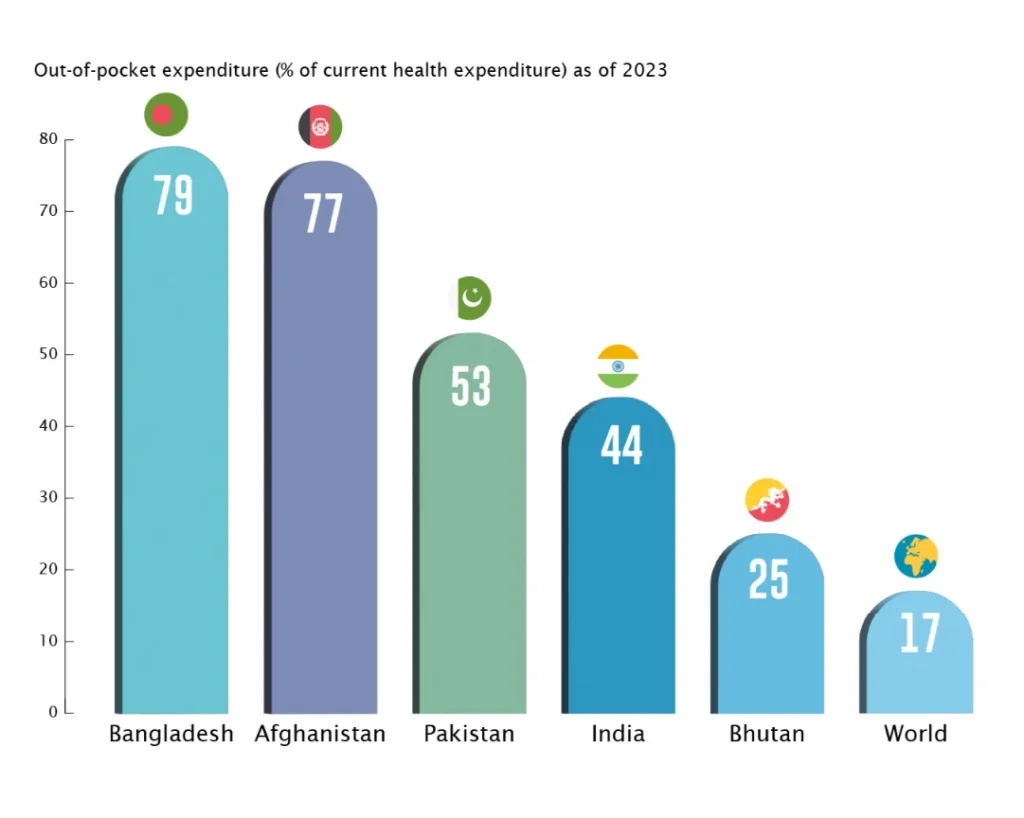
Pakistan has the highest neonatal mortality in the world, along with high maternal mortality and one of the lowest life expectancies in the region, as described by Macro Pakistani before. It is of course no coincidence that Pakistan is also one of the lowest spenders on health in the region, spending a small share of general government expenditure on healthcare compared to countries such as Thailand and neighbouring Iran. The low public investment in health means that people continue to spend heavily out of their own pockets, with out-of-pocket (OOP) payments still accounting for the majority of Pakistan’s current health expenditure.
In 2023, households financed 53% of Pakistan’s total health spending out of pocket
Universal Healthcare (UHC)
So, how is this linked to UHC? UHC means that all people have access to the health services they need, when and where they need them, without financial hardship. High OOP payments can lead to financial hardship in the form of catastrophic ‘health expenditures’, or impoverishment due to health expenses. As the charts below show, approximately 9% of all households in Pakistan face catastrophic health expenditures (10% of all expenditures), and 0.5% have been driven below the poverty line as a result of health expenses. This may seem small, but it accounts for 20% of all households living below the poverty line. At the national level, the most recent UHC Monitoring Report, compiled by the Ministry of Health with WHO and the British High Commission, puts the 2024 toll at over 14.8 million people facing catastrophic health expenditures and 11.1 million pushed below the $2.15/day poverty line due to out-of-pocket medical costs. For very poor families, high OOP costs can also deter people from seeking care at all.
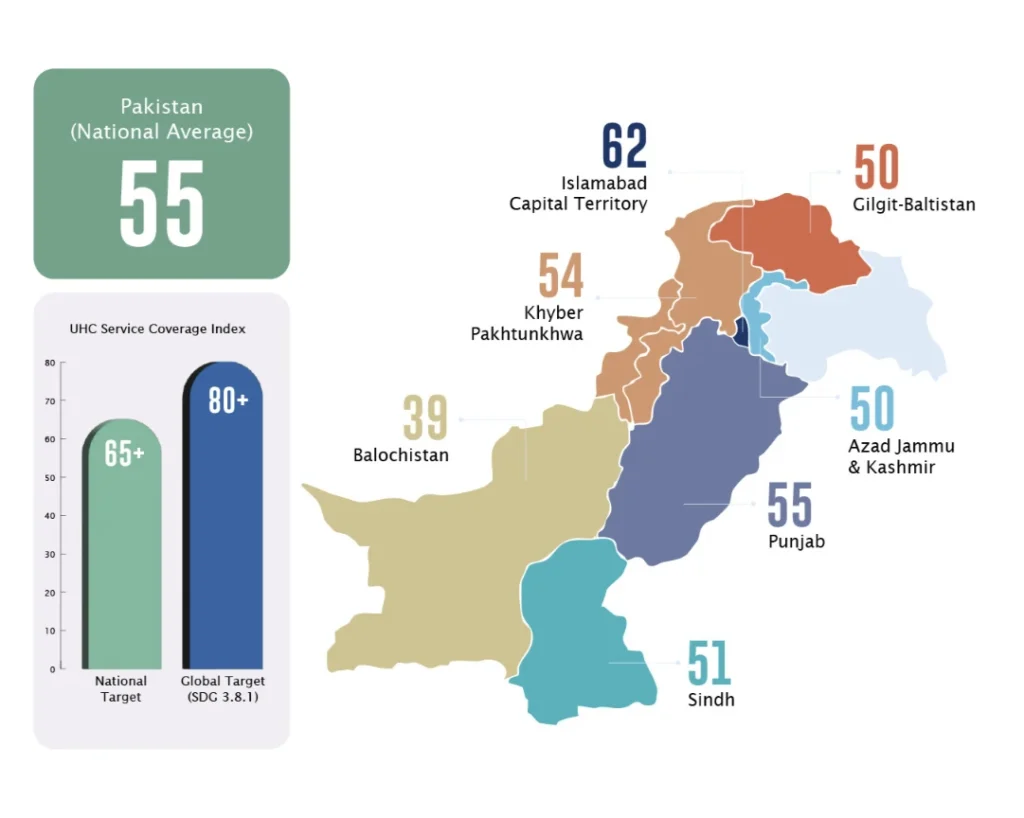
Pakistan’s UHC service coverage index, a broader WHO/World Bank measure of how well essential health services actually reach people, rose from 40 in 2015 to 56 in 2023, though the global 2030 target sits at 80. Sehat Sahulat, Pakistan’s flagship social protection scheme, can help families access care without financial risk. But understanding how far it can carry Pakistan toward UHC means first understanding what the programme looks like today, and that picture now varies sharply by where a family lives.
What is Sehat Sahulat in 2026?
Pakistan’s Universal Health Coverage (UHC) Service Coverage Index stood at 54.7 in 2024, leaving the country well below its national target of 65.
UHC Coverage Index in 2024
For years, Sehat Sahulat operated as two parallel systems: a federal programme and a provincial one run by the Government of Khyber Pakhtunkhwa. That split has now hardened into something closer to a permanent divide. The federal programme’s earlier phase ended in June 2025, and coverage was suspended for months before the Prime Minister approved its continuation on January 2, 2026, limited to Islamabad Capital Territory, Azad Jammu and Kashmir, and Gilgit-Baltistan. The programme was formally relaunched in these three federal territories on January 16, 2026, this time run through the development budget on a universal basis rather than only for households below the poverty line, and extended with a fresh PKR 40 billion allocation. Punjab, Sindh, and Balochistan now run their own provincial versions, funded and administered separately; in Punjab, Sehat Card services are currently only available at private hospitals.
Khyber Pakhtunkhwa has taken its provincial programme, Sehat Card Plus, the furthest. It now covers all of KP’s population, more than 10.6 million families, with no income-based eligibility test, and offers up to PKR 1 million per family per year along with an attached life insurance component. High-cost transplant care, including kidney, liver, and bone marrow transplants, is now bundled in under a dedicated “Jwandun Card.” As of January 2026, hospitals must also hold a Healthcare Commission KP license to stay on the programme’s panel, a quality-control step the earlier version of the programme did not require.
The coverage limits that originally distinguished the federal and provincial programmes, tertiary and secondary care caps that differed by province, are becoming less useful as a comparison point now that each province is setting its own rules independently rather than following a shared federal template. What has stayed constant is the basic model: cash-free inpatient treatment for a defined list of priority conditions, delivered through a mix of public and empanelled private hospitals, verified against NADRA records.
Strengths of Sehat Sahulat
Note by editor (2026): Despite repeated changes in programme design, funding, and administration, many of the strengths and limitations discussed below remain relevant today. The analysis, therefore, focuses on the underlying policy approach rather than any single version of the programme.
The programme prioritizes the vulnerable, where it still targets them: The federal programme originally targeted households living below the poverty line, the group that would find it hardest to pay for inpatient treatment out of pocket. That targeting logic has since been replaced in the federal territories by universal coverage, and KP abandoned income-based eligibility even earlier. Universal coverage removes the risk of wrongly excluding a poor household, but it also means a shrinking share of programme spending is explicitly directed at people who need it most, an efficiency trade-off worth watching as provinces expand their programmes.
The programme effectively leverages the private sector: Different studies show that private sector utilization can be as high as 80% in Pakistan. Estimates from the national health accounts show that over 80% of all health expenditure occurs in the private sector. Sehat Sahulat gives government an effective way to draw on existing private hospital infrastructure while making sure beneficiaries are not paying out of pocket. This approach is also consistent with global evidence, which points to private sector engagement as a critical piece of the puzzle for low- and middle-income countries working toward UHC.
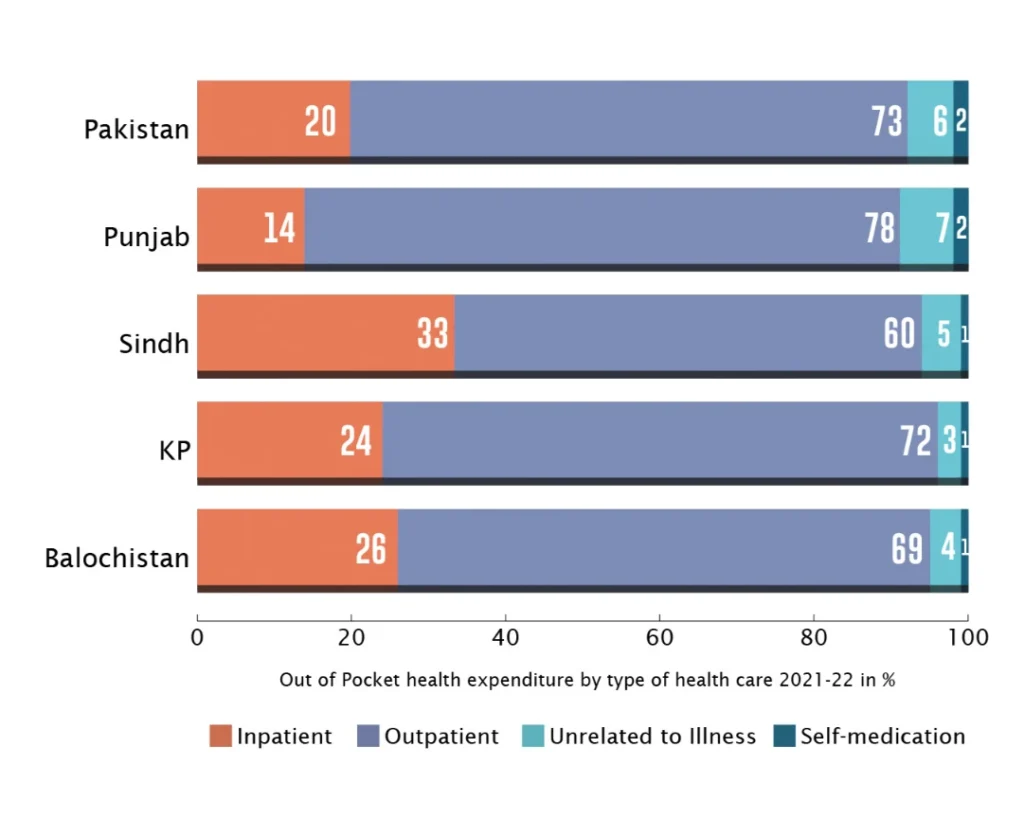
Outpatient care accounts for the largest share of out-of-pocket health spending in every province, ranging from 60.0% in Sindh to 77.5% in Punjab.
Opportunities for Sehat Sahulat
The federal and provincial versions of Sehat Sahulat remain genuinely important social protection tools. But the programme’s current shape, especially its geographic fragmentation, still leaves real gaps on the road to UHC.
Outpatient care is finally being addressed, but only in one province so far: For most of Sehat Sahulat’s existence, the entitlement covered almost exclusively inpatient procedures, surgical care, and emergency treatment, with antenatal visits and post-admission follow-ups as the main exceptions. That mattered because more than 80% of health facility utilization in Pakistan is for outpatient (OPD) visits, not inpatient care, and OPD spending is the single biggest driver of both impoverishment and catastrophic health expenditure across all provinces. KP has now moved to close this gap: a KfW-funded pilot brought free OPD services to four districts, Mardan, Kohat, Malakand, and Chitral, starting in 2024 and 2025, and in July 2026 the KP cabinet approved a province-wide Health Policy that extends free OPD coverage under the Sehat Card to the entire province, alongside new investment in basic health units, school health services, and telemedicine. This is a genuinely significant shift, since it targets the exact gap that limited the programme’s impact on catastrophic spending. But it is a KP-only reform for now. Households in Punjab, Sindh, Balochistan, and the federal territories still rely on a programme that covers inpatient care almost exclusively, meaning the illnesses that drive the most financial hardship, lower respiratory infections, hypertension, mental health conditions, dental care, remain largely unprotected outside KP.
Coverage now depends heavily on where you live: The old critique, that the federal programme’s poverty-line eligibility test missed a large share of genuinely poor households, has been partly overtaken by events: the federal programme moved to universal coverage in the territories it still serves. But that programme now only operates in Islamabad, AJK, and Gilgit-Baltistan, a small fraction of Pakistan’s population. Everyone else depends on their province’s own programme, and those differ substantially in generosity, eligibility rules, and what they cover. A family’s access to cash-free healthcare in Pakistan today is shaped less by need and more by which province’s CNIC they hold, an outcome that sits uneasily with UHC’s basic promise of care for all, regardless of where they happen to live.
How to Save More Lives?
The current benefit package may still not save the most lives, in any province. The “benefit package” for Sehat Sahulat refers to the diseases covered under the programme. Typically, what gets covered under a national insurance scheme or public provision is based on local evidence about which treatments are cost-effective, since more cost-effective treatments save more disability-adjusted life years per rupee spent. Every government works with a constrained budget, so a choice between funding chemotherapy or an angioplasty, for the same money, should ideally go to whichever option saves more disability-adjusted life years.
Over the last two decades, global partners including the World Bank, the University of Washington, and the Gates Foundation have compiled evidence on cost-effective health interventions for low- and middle-income countries through the Disease Control Priorities (DCP) initiative. Its most recent update lists 219 interventions shown to be cost-effective across these countries, and notably, renal dialysis and treatment for all forms of cancer do not make that list. Pakistan’s provinces may be able to save more lives for the same money by investing more heavily in OPD care and preventative health, which is exactly the direction KP’s 2026 policy is starting to move in, rather than in the high-cost tertiary procedures that dominate current benefit packages.
The national effort to contextualize DCP recommendations to Pakistan’s own evidence base and define a locally appropriate benefit package, led by the Ministry of National Health Services, Regulations and Coordination, is still ongoing. As provinces increasingly design their own programmes independently, this kind of shared technical evidence base becomes more important, not less, since it is one of the few things that could still pull Pakistan’s now-fragmented health insurance landscape toward a coherent, cost-effective national standard.
Original Author, ‘Wajeeha Raza’, analysis from the archive of Macro Pakistani.
Updated in 2026 by Macro Pakistani’s Head of Content Research, Sharmeen Sajjad.