
The Hidden Selection Process Behind Public Development Projects
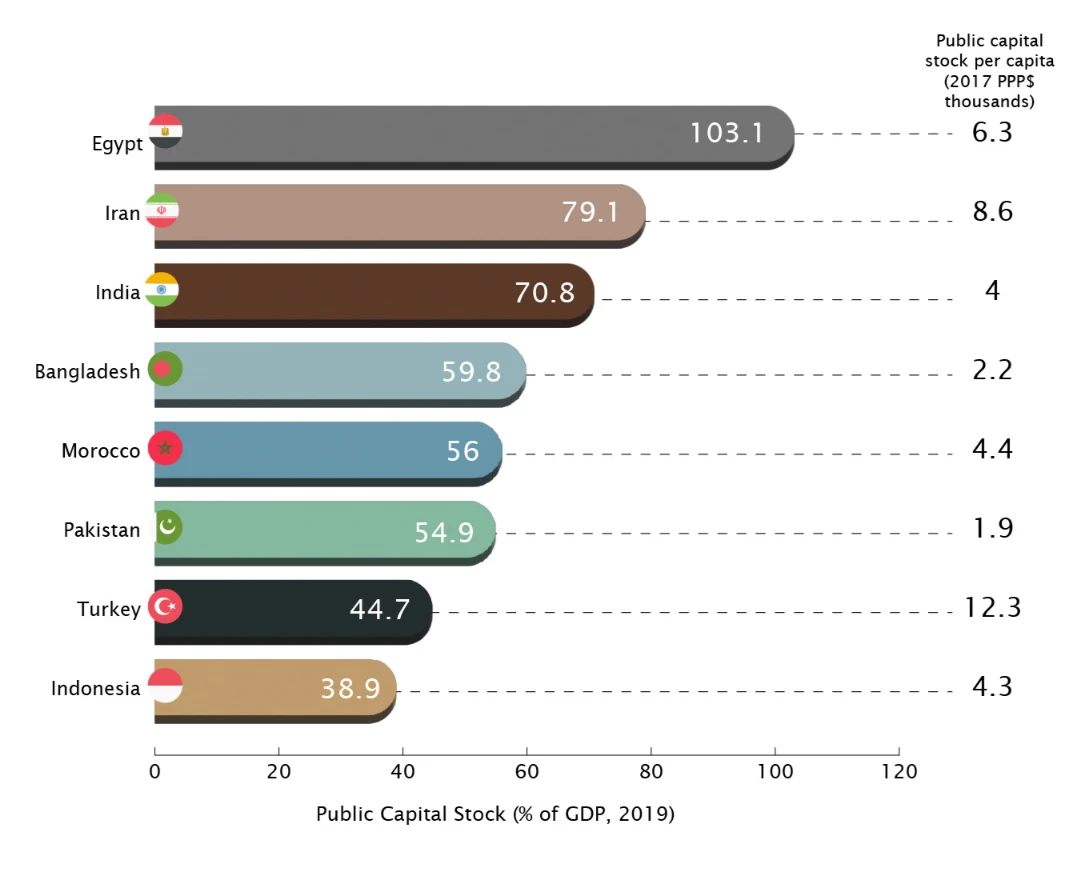
Pakistan’s public capital stock is among the lowest in its peer group, both as a share of GDP and per person. That matters because a country that has invested this little in public capital can least afford to get its remaining choices wrong.
Level of Public Capital Across Peers
Public capital stock as a share of GDP and per-capita public capital stock across selected emerging economies, 2019
The Question Before the Project
One of the things I have always found interesting about Pakistan’s infrastructure debate is how quickly we begin talking about a project as though it were the starting point.
A new road is announced, and the conversation turns to its route, cost, and completion date. A public transport project is proposed, and we debate ridership, fares, operating subsidies, and whether it can ever “pay for itself”. A new housing society is launched, and the discussion moves almost immediately to how much land will be developed and what it might eventually be worth.
These are all perfectly reasonable questions. But they come after another, much more fundamental one: why did we decide to do this in the first place?
That was the question that initially interested me in transport, where the difference in how we evaluate various forms of infrastructure is particularly obvious. But the more I have looked at Pakistan’s public investment system, the more I have realised that the issue is much wider than roads or railways. Every year, governments make choices between hospitals and highways, universities and water schemes, urban regeneration and rural connectivity, new projects and the completion of old ones. In each case, scarce land, money, and institutional capacity are being committed to one course of action rather than another.
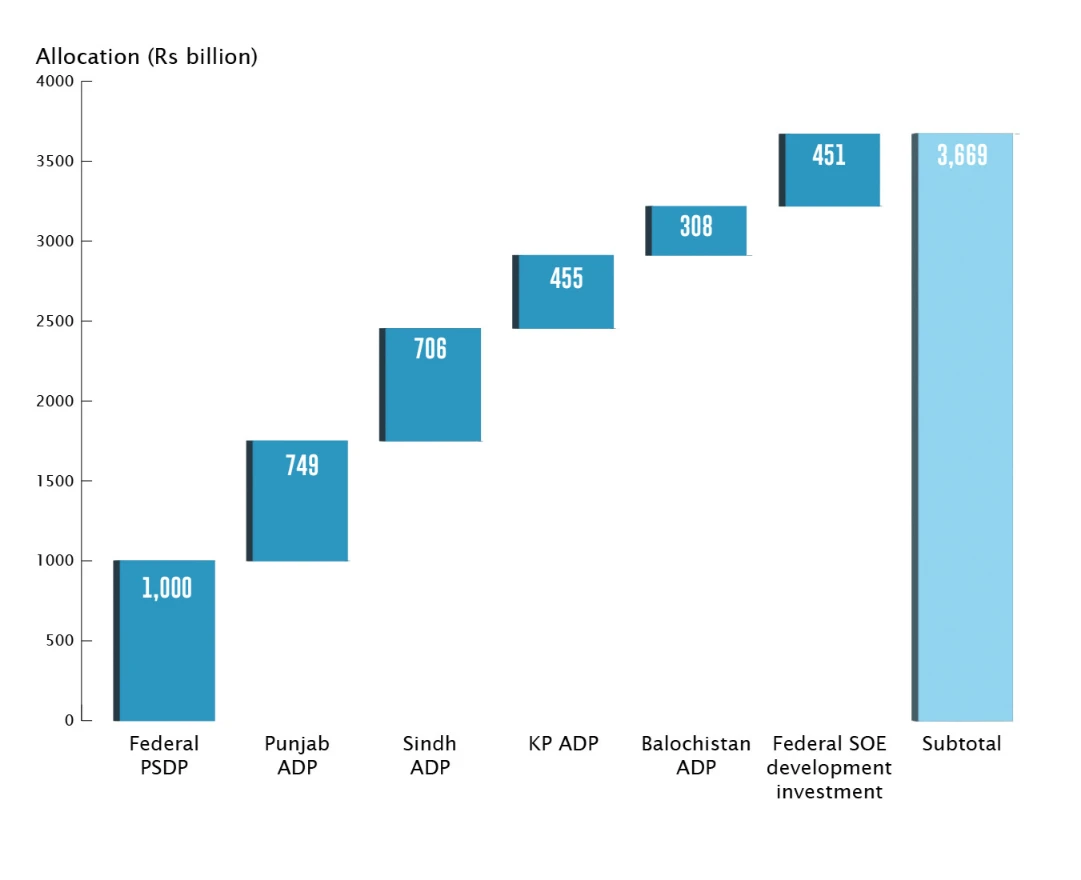
The latest federal Public Sector Development Programme alone allocates PKR 1 trillion across a portfolio of projects covering infrastructure, health, education, technology, water, and other sectors. It tells us what these projects cost, when they were approved, how much has already been spent, and how much they will receive this year. As researchers, taxpayers and citizens, we should also be able to ask a more basic question.
Why these projects?
Federal Development Priorities
Development allocations for federal ministries and divisions in Pakistan’s FY2025–26 and FY2026–27 budgets.

Pakistan’s System for Development Projects
The easy criticism would be that Pakistan simply lacks a system for appraising development projects. Having spent some time going through the government’s own documents, I do not think that is accurate.
In fact, some of the principles are surprisingly good, and they are not particularly new.
The Planning Commission’s 2019 Manual for Development Projects describes a complete project cycle running from identification and appraisal through implementation, monitoring, and eventual ex-post evaluation. More importantly, it makes a point that gets to the heart of what appraisal is supposed to achieve: it is not enough for the benefits of a project simply to exceed its costs; a proposed investment has to be compared with other feasible investments, because the relevant question is whether those scarce resources could produce greater benefits somewhere else.
That thinking did not begin in 2019. A 2017 working draft already emphasised alternatives and warned against spreading limited resources across too many projects, while a 2020 reform programme called for prioritised project pipelines and stronger appraisal capacity.
The same manual requires feasibility work, consideration of the population being served, assessment of project benefits, stakeholder consultation and subsequent comparison of actual outcomes with the projections made when the investment was originally approved. It even says that project-level release data should be published to provide user-friendly information to researchers, academia, and the public. A 2010 version of the Manual was already explicit that project approval and PSDP selection were separate exercises, because limited funds required choosing a small number of projects from a much larger portfolio. It also described appraisal as providing decision-makers with the economic and financial basis for choosing among competing alternatives.
In fact, the deeper I went into the Planning Commission’s own archives, the harder it became to argue that Pakistan’s problem is simply that nobody has thought about these questions. Feasibility requirements for major projects go back at least to the late 1980s, while a 2017 draft of the development manual explicitly discusses alternatives, opportunity costs, and the need to link projects to available resources. By 2020, the government’s own reform programme was describing appraisal criteria as outdated, project pipelines as largely unavailable and specialist planning capacity as limited, while proposing stronger appraisal capability, prioritised pipelines, and greater digitisation
The 2024 Manual takes this architecture further, with updated guidance on appraisal, feasibility, risk, monitoring, evaluation, and climate considerations, while explicitly describing public investment planning as an evidence-based exercise for allocating scarce resources to the collective priorities of citizens. So, the problem is not that nobody in government has thought about these questions. The more serious problem is the gap between what the manuals say should happen and the projects that eventually appear in front of us.
Appraising A Project Is Not the Same as Choosing It
This distinction was made particularly clearly in the IMF’s 2023 Public Investment Management Assessment of Pakistan. The assessment found that Pakistan already had a substantial formal appraisal system: major projects were technically reviewed and larger investments were expected to undergo financial and economic analysis. But crucially, the resulting appraisals were not published or subjected to independent external review, while the subsequent process for choosing between technically approved projects lacked comprehensive published selection criteria.
This is the important part to understand. A project can be economically sensible and still not be the best project to build.
If ten projects are viable and the government has enough money for three, the difficult decision begins after appraisal rather than ending with it. One project could have a larger economic return, another could serve a poorer region, while another could respond to a pressing social need, and the fourth could be strategically important for reasons that cannot easily be monetised. Governments obviously must make those judgements. There is no way of taking politics, priorities or distributional choices out of the process altogether.
But we should, however, be able to understand how those judgements were made, particularly when they emerge from a chain of ministerial, technical and political decisions rather than from any single test or approving authority.
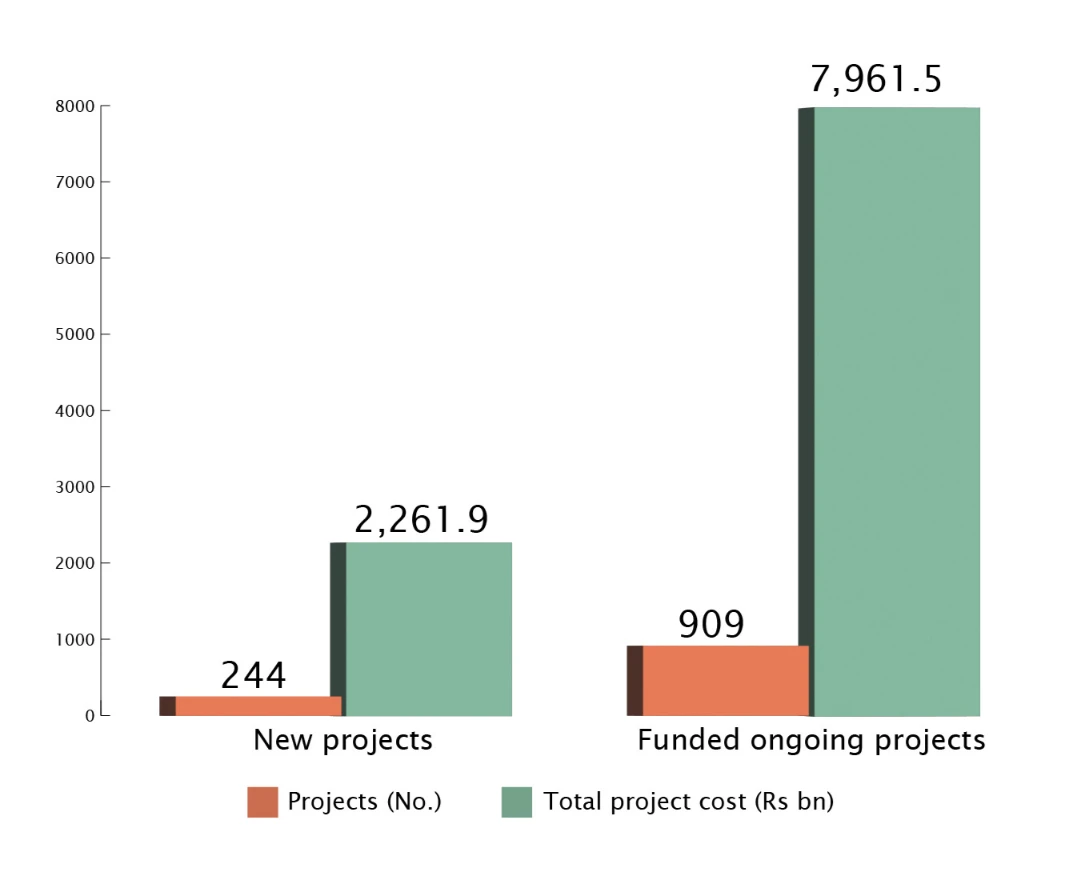
This becomes even more serious because Pakistan does not have the luxury of carrying an unlimited investment portfolio. The PIMA estimated that, at the time of its assessment, completing the projects already in the PSDP would cost PKR 10.7 trillion, more than fourteen times the annual development allocation of PKR 727 billion, even as another PKR 2.3 trillion of new projects had been added. It concluded starkly that the PSDP was unaffordable in its existing form. Once the pipeline is that large, every additional project carries a significant opportunity cost.
The Development Project Backlog
Number and cost of federal development projects, including new and ongoing projects, and the estimated cost and completion time for ongoing projects.
| Funding indicator | Value/No. of years |
| FY2022–23 development allocation | PKR 727.5 Billion |
| Cost to complete ongoing projects (“throw-forward”) | PKR 10,729 Billion |
| Estimated years to completion at current funding | 14.1 years |
Principles to Methodology
The reforms that have followed were therefore less a discovery of the problem than another attempt to close a gap the planning system had recognised for years. What changed in January 2025 was that relatively broad principles of prioritisation were turned into a much more explicit methodology for scoring and ranking projects.
The Planning Commission’s Project Selection Criteria and Methodology openly acknowledges many of the problems identified above, including limited fiscal space, too many projects, thin allocations, increasing throw-forward and insufficient prioritisation. It then sets out a process in which viable projects are supposed to be scored and ranked before high-ranking projects are selected for the PSDP.
Within sectors, ministries are supposed to rank projects according to defined technical, economic and financial parameters. The Planning Commission then carries out a cross-sector comparison incorporating strategic alignment, urgency, economic impact, social impact, environmental sustainability, fiscal risk, technical feasibility, economic and financial return and regional considerations.
That is ‘meaningful progress’, and it deserves to be recognised as such.
The 2026–27 PSDP itself says that strict control over new schemes has been maintained through the adoption of selection criteria and alignment with the country’s strategic needs. We therefore now have a published methodology for how projects should be selected that we did not have before.
Which raises the next question.
Development Spending by Tier
Federal, provincial and state-owned enterprise development allocations under Pakistan’s FY2026–27 development programme.
Clear Rules and Unclear Decision Making
If projects are being scored, ranked, and compared, where are those results?
I tried this myself with several schemes in the current PSDP. It is relatively straightforward to find their costs, approving forums, previous expenditure, and current allocations. What I could not readily find in the public material was the appraisal summary, the score or ranking produced by the selection process, the alternatives against which the project was assessed, or the assumptions that ultimately made it preferable to competing investments. That does not mean those analyses were never undertaken. In fact, the formal framework suggests that much of this information should exist somewhere inside the system. The point is that an outsider cannot easily reconstruct the decision from the public record.
This is particularly striking because some of this information is not simply a “nice to have” for an outside researcher. The current PC-I itself asks sponsors to provide a project’s ranking among investment-ready projects. As such, part of the analytical footprint we are asking to see is therefore already supposed to be generated inside the system.
But this does not mean that every cabinet conversation or internal government exchange needs to be made public. Nor should every public investment decision be reduced to an algorithm. A scoring system does not remove judgement from policymaking, and neither should it.
But if the deliberation itself cannot always be public, surely enough of its inputs and outputs can be.
That distinction becomes particularly important at the level of our cities, where some of the most consequential decisions can reshape land use, mobility, and economic geography for decades.
Most of the architecture I have described so far governs federal development spending. Provinces have their own ADPs and planning processes, while city-level and specialised development authorities may operate through different institutional arrangements. But the underlying questions do not disappear simply because the institutional route changes. What problem is being solved? What alternatives were considered? Why was one option preferred, and how will success eventually be judged?
Consider something like the redevelopment of Lahore’s former Walton Airport site as a new central business district. I am not making an argument here about whether that was the right or wrong use of the land. My question comes before that judgement.
What problem was the intervention intended to solve? What alternatives were considered, and why was a central business district judged to be the best use of the land? What evidence was used to forecast demand and its wider effects on employment, transport and surrounding communities?
These are not particularly radical questions. They are simply the questions that allow us to move from what is being built to how the decision to build it was made.
Learning the Language of Program Planning
This is perhaps where Pakistan differs from more mature public investment systems in a way that cannot be fixed simply by issuing another manual. Interestingly, Pakistan’s own reform efforts recognised this problem. A 2020 reform programme proposed dedicated Project Planning and Development Units in major ministries, staffed by economists, project-appraisal specialists, monitoring and evaluation experts, financial-management specialists, environmental specialists and others. The implication is important: a good appraisal system cannot be created simply by designing the right form. It requires people who know how to use it, institutions that repeatedly practise it, and eventually a wider professional community that understands what good appraisal is supposed to look like. In other words, appraisal has to become more than a step in the project approval process. It has to become part of how public investment is discussed.
In the UK, frameworks such as HM Treasury’s Green Book, the Magenta Book and the Five Case Model have become part of a recognisable professional language around public investment and a common framework within which disagreements can take place. They apply to government interventions rather than being a general requirement on purely private development, which instead passes through the planning system; but once public money or public intervention is involved, there is a widely understood expectation that somebody should be able to articulate the strategic case, examine alternative options, establish the economic case, consider how the proposal will be delivered and financed, and explain how success will eventually be evaluated.
Simultaneously, there are legitimate criticisms of that system. Appraisal can become cumbersome, business cases can turn into exercises in procedural compliance, and worthwhile investments can get trapped in years of analysis. More process does not automatically produce better government.
But there is still value in having a shared standard to argue about, which gives consultants, academics, journalists, legislators and others a basis on which to question the case being made for a project, rather than simply debating the project once the decision has effectively been made.
In Pakistan, outside relatively small specialist circles, infrastructure appraisal barely features in our academic, consulting or public-policy conversation in the same way. We debate projects extensively, but we do not routinely debate the appraisal that produced them. There is a difference between having people inside the government who know how to appraise a project and having an ecosystem that expects the case for that project to be explained and challenged.
Without it, it’s much easier for the project itself to become a fait accompli before the wider public ever encounters the reasoning behind it.
Focusing on Transparency
Transport for London’s (TfL) published framework for evaluating the Elizabeth line provides a useful illustration of this difference, not because British institutions invariably make better decisions, but because more of the decision can eventually be interrogated.
TfL publicly sets out what the railway was expected to achieve, distinguishes the infrastructure that was delivered from the benefits and wider outcomes it was supposed to produce, identifies indicators against which those outcomes will be measured, recognises that the project may also create disbenefits, and commits to gathering evidence after opening to test whether the expected benefits actually materialised. It does so to demonstrate value for money to the public and funders, respond to external scrutiny, and learning lessons that can shape future investment.
Interestingly, Pakistan’s own manuals aspire to much the same thing. Ex-post evaluation is already supposed to compare actual outcomes with the projections made at appraisal. The difference is that the PIMA found that relatively few projects actually completed those ex-post reviews, despite Pakistan already having strong internal systems for collecting project-level information.
That, to me, is the transparency gap worth focusing on. The state already generates information. It already has appraisal rules. It now has explicit selection criteria. It has monitoring and evaluation frameworks. But what we cannot easily see is the analytical chain connecting them.
Opening Up the State’s Decisions to ‘Public’s Scrutiny‘
Opening that chain to greater scrutiny would not mean dumping thousands of pages of PC-I documents online and expecting citizens to become economists. For major projects, a reasonable minimum public record should be much simpler and include a short business-case summary setting out the problem being solved, the principal alternatives considered, the assumptions on which the case rests, the project’s score or ranking where one exists, the outcomes it is expected to deliver and, eventually, whether those outcomes actually materialised.
Researchers can then test the assumptions. Journalists can question them. Parliament can scrutinise the choices. Communities can ask whether the needs attributed to them resemble their actual experience. And the government is better able to face scrutiny when the evidence backs up their decisions.
Naturally though, transparency will not eliminate bad decisions, and appraisal shouldn’t remove politics from public investment. What it can do is make the assumptions and judgements behind those decisions contestable.
Pakistan has spent years developing rules for how projects should be identified, appraised, selected and evaluated. The next step is therefore not another rulebook or guidance but allowing more of us to see how the existing one is being used.
That also leaves another question for later: once a project has been selected, does changing how it is financed, including through private finance, change whether it was worth building in the first place?
But the principle extends beyond infrastructure. Citizens experience the state every day through service providers, regulators and departments whose decisions can be just as consequential and just as difficult to interrogate. How accountable is a service provider to the regulator? How accountable is that regulator or ministry to the legislature, and ultimately the legislature to the voter? If an ordinary citizen cannot understand why a decision was made, what standard was applied, who is responsible for it, or how it can be challenged, the public sector begins to resemble a black box in which whatever the mehkma says simply becomes the answer.