
Markets that look informal are not always inefficient. Pakistan’s agricultural supply chain evolved mechanisms for financing, trust, and risk-sharing that technology startups underestimated.
Agritech companies lose money all over the world. So what?
Losing money while trying to solve a genuinely difficult agricultural problem is understandable. If the bet pays off, the gains extend well beyond investors to farmers, consumers, and the broader food system, and the opportunity in Pakistan is real. Estimates suggest that wider adoption of agricultural technologies could increase crop yields by as much as 30%, reduce post-harvest losses by up to 75%, and generate an additional US$8–10 billion in annual economic value. The question, now, is beyond whether Pakistan needs agritech. It is where technology creates the greatest value.
The first generation of venture-backed agritech startups largely focused on reorganising the farm-to-market supply chain. In hindsight, they were trying to optimise one of the more efficient parts of Pakistan’s agricultural economy while many of its deeper productivity constraints remained largely untouched.
What is harder to justify is losing money trying to solve a problem that did not exist.
That is what happened with Pakistan’s farm-to-market agritech startups. Roughly US$15 million was invested in the thesis that Pakistan’s wholesale supply chain was fundamentally broken. Most of that capital is now gone—not because the founders failed to execute, but because they misread the economics of the market they were trying to disrupt.
Context
In the years following COVID, interest rates globally were near zero. Capital was cheap and chasing growth everywhere, including frontier markets like Pakistan. For a country where high-risk ventures had historically struggled to attract funding, the arrival of venture capital in the millions was genuinely new.
Careem’s acquisition by Uber had already shown what was possible. The idea of building a company toward a large exit felt real. Around the same time, Indian fresh produce startups like Ninjacart were raising large rounds on the premise of organising the agricultural supply chain, connecting farmers directly to retailers and cutting out the layers in between. The market size was gigantic. The problem looked obvious.
Pakistan’s fruit and vegetable supply chain appeared, at first glance, to be a carbon copy of India’s. Farmers sold to intermediaries, produce passed through wholesale markets, and retailers bought from commission agents before reaching consumers. The chain looked fragmented, informal, and crowded with middlemen. If the same structure in India was attracting hundreds of millions of dollars in venture capital, it was easy to assume Pakistan presented the same opportunity.
Fresh produce supply chain for a typical small-scale farmer in Pakistan
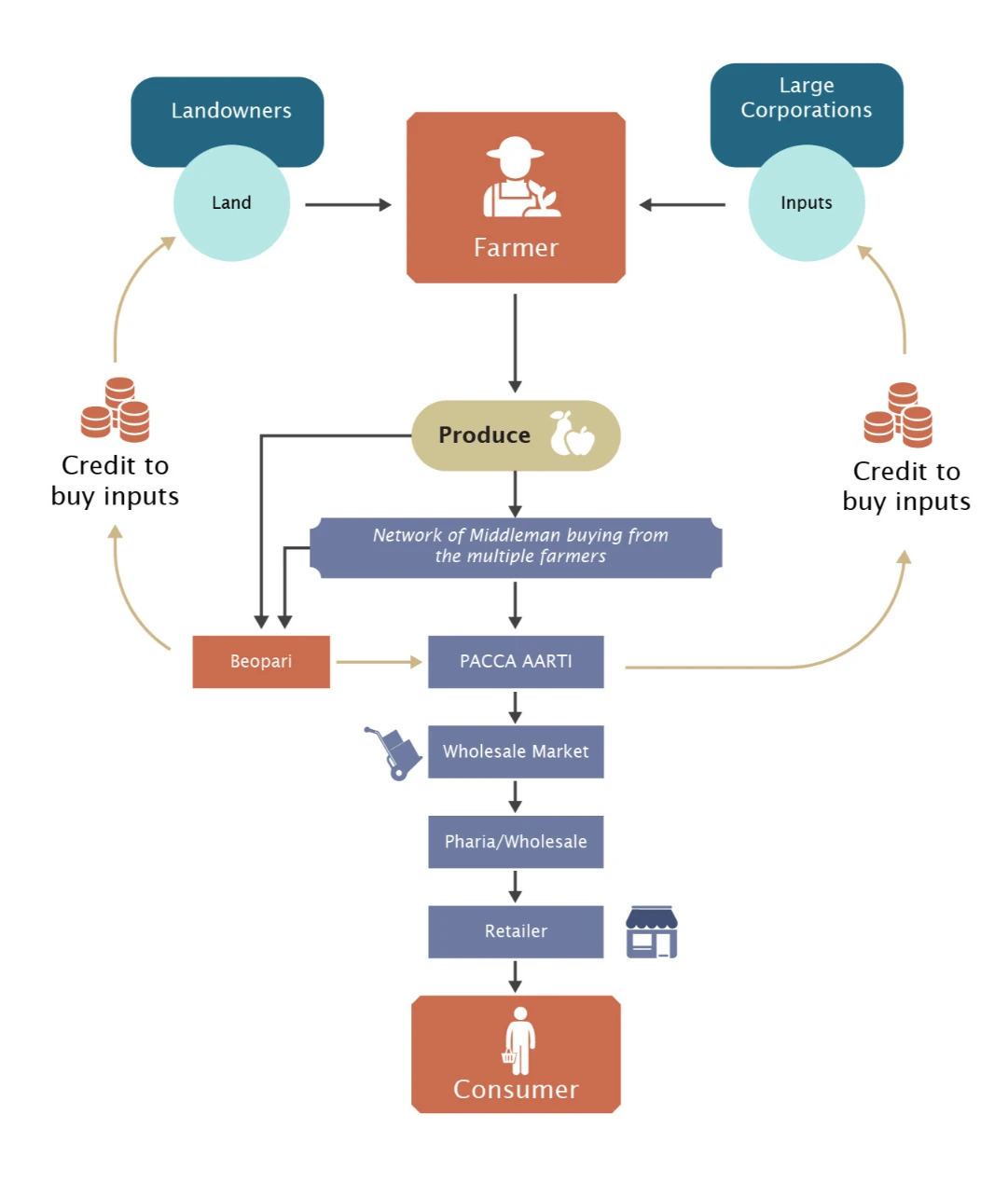
Source: MHRC, LUMS
The investment thesis was straightforward. Indian agritech startups such as Ninjacart argued that too much value was being lost between the farm and the consumer. By sourcing directly from farmers and supplying retailers themselves, they promised to reduce wastage, improve prices for growers, lower costs for buyers, and earn healthy margins in the process. Investors rewarded that thesis with large funding rounds, betting that technology and logistics could replace a long chain of intermediaries.
To entrepreneurs in Pakistan, this looked like an arbitrage opportunity. In finance, arbitrage is the idea of exploiting a price difference between two markets. Venture capital often looks for a similar kind of gap: if a business model has already been validated in one market, but has not yet been replicated in another that appears structurally similar, the second market offers the chance to recreate the same success before others do. Pakistan seemed to fit that description. Capital had become available, the addressable market was enormous, and the supply chain looked almost identical on the surface.
The assumption, however, was that the visible structure reflected the underlying economics. It did not. While Pakistan’s supply chain looked similar to India’s, it operated under a different set of incentives and institutions. The apparent inefficiencies that attracted investment were, in many cases, not inefficiencies at all. They were adaptations to a market that had evolved over decades to manage credit, price volatility, and perishability. That distinction would prove far more important than the similarities.
Hypothesis Building
In the summer of 2015, I was an equity analyst covering fertiliser companies when Ninjacart appeared in my newsfeed. I followed the company and in the process found out about Twiga Foods, founded by an Oxford-trained PhD based in Kenya. Then in 2018, Mandi Express emerged in Pakistan with a similar model. By late 2019, I was increasingly convinced that the model worked. These companies had raised capital and were growing fast. Mandi Express’s fundraise, led by a leading financial institution in early 2020, left me with little doubt.
I was inclined toward Twiga Foods’ model. It started with a single product, bananas, sourced from a dedicated supply zone with year-round, relatively stable output. It resembled a factory more than a farm. Predictable, scalable, financeable.
I wanted a piece of the action. I started researching Karachi’s banana supply chain. Around the same time, a friend mentioned that a young, foreign-educated man from Lahore, a fifth-generation middleman (commonly known as Arthi), was working on a similar model. I felt the window narrowing. That person was Ali Wafa. We later co-founded Indus Acres.
Where the $15 Million Went
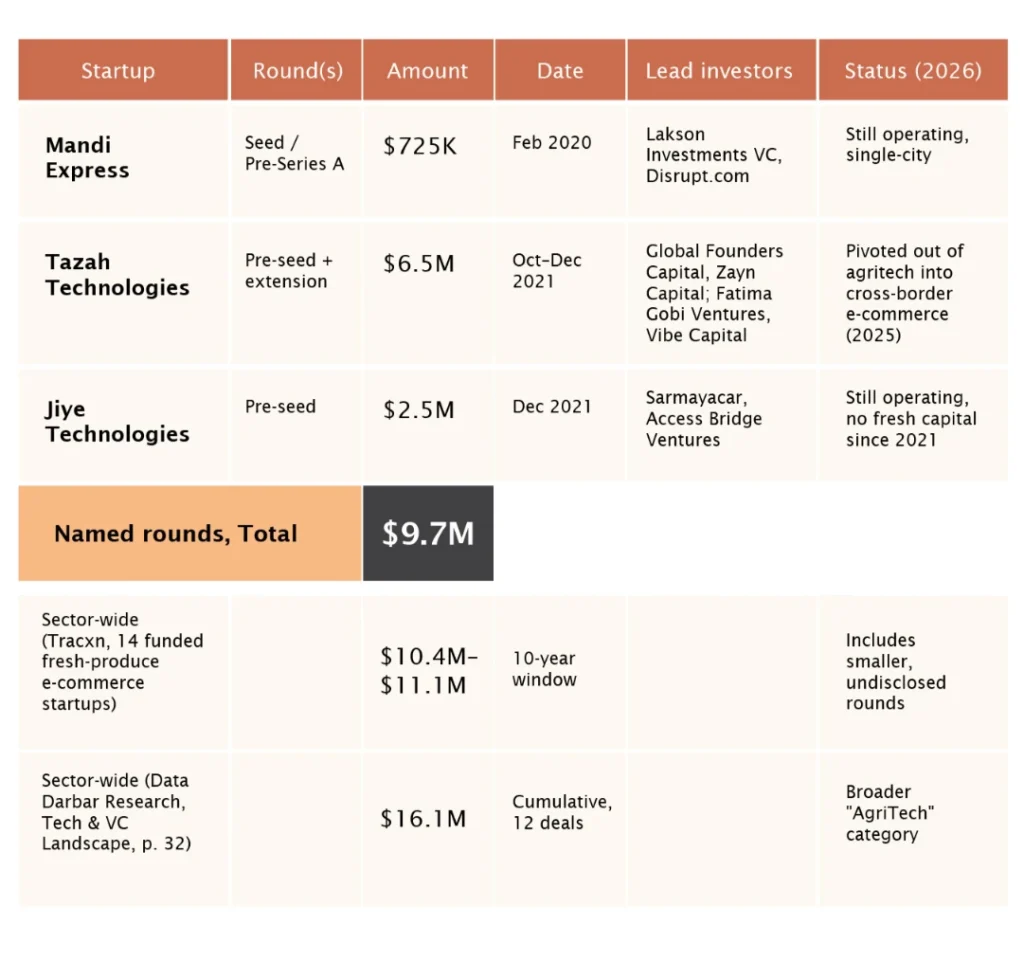
By late 2021, three startups had raised within months of each other, each citing the same broken-middleman thesis. Eighteen months later, the sector was already retreating.
Uncomfortable Reckoning
My research kept returning an uncomfortable result. I work in public markets, where much of the job is identifying situations in which prices diverge from underlying value. The opportunity lies in mispricing. If an asset is correctly priced, there is no arbitrage. I had approached Pakistan’s fruit and vegetable supply chain with the same mindset, convinced there must be value trapped somewhere in the middle.
Instead, the opposite kept appearing. The no-arbitrage condition largely held. The supply chain was far more efficient than it looked.
I struggled to accept the conclusion because it ran against the prevailing narrative. The assumption behind most farm-to-market startups was that intermediaries were capturing excessive margins by buying cheaply from farmers and selling dearly to retailers. If that were true, removing them should have unlocked meaningful value for everyone else in the chain.
The data suggested otherwise. Margins were not accumulating in the middle. They accrued at the two ends of the chain. Farmers earned returns for bearing production risk, uncertain weather, pests, disease, and fluctuating yields. Retailers earned higher margins because they sold in small quantities, carried inventory risk, and faced uncertain daily demand. The participants in between operated on relatively thin commissions, competing on volume rather than price. They were being paid for a service: aggregating produce, arranging transport, extending credit, sorting quality, financing inventories, and matching buyers with sellers. They were not extracting monopoly rents.
This is not unique to Pakistan. Recent economic research shows that long trading chains often emerge because intermediaries reduce fixed costs associated with search, transport, licensing, financing, and market access. For a retailer buying relatively small quantities, purchasing through a wholesaler is often cheaper than sourcing directly from farms, even if the unit price is slightly higher. In that sense, multiple layers of intermediation are not necessarily evidence of inefficiency. They are often the market’s solution to high transaction costs.
The evidence also mirrors what I was observing. Research on developing-country markets finds that traders further upstream face more competition and therefore earn lower markups, while value concentrates closer to production and final retail. Evidence from Pakistan’s wholesale markets reaches a similar conclusion. Although farmers receive less than half of the final retail price for commodities such as potatoes and onions, the remainder is largely absorbed by transport, packaging, labour, storage, spoilage, and logistics, alongside relatively modest commissions earned by different market participants. It is not simply a case of intermediaries pocketing the difference.
The chart below illustrates how value is distributed across the banana supply chain. While the prices are from 2022, the distribution of value has remained broadly consistent over time. The middle of the chain earns service fees. The economic rents sit at the two ends.
The Agriculture Value Chain
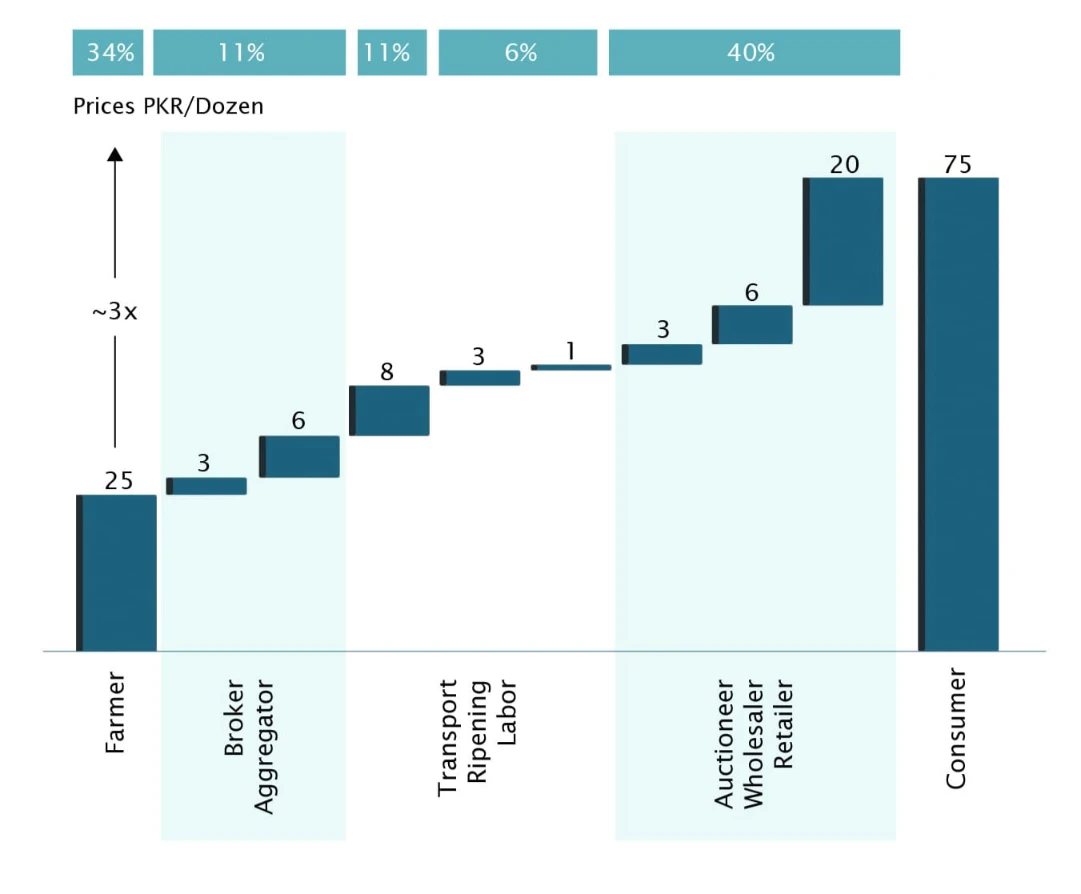
The chart illustrates margin accretion to each stakeholder. Prices are from 2022, but the value distribution is consistent over time. The middle earned fees while the ends earned a margin.
The confirmation came in 2021 when I finally met Ali Wafa (Co-founder Indus Acres). We had arrived at the same conclusion through entirely different paths. Mine came from analysing prices and incentives. His came from operating inside the supply chain as a fifth-generation Arthi. Both pointed to the same answer: the market had already competed away the easy profits. By then, I had shifted upstream and was growing bananas myself.
Market structure: Spot vs Forward
Auction markets are self-correcting by design. Fresh produce markets are live auctions where prices are discovered in real time based on what arrives that morning, what buyers need, and what competing sellers are offering. Prices can rise or fall dramatically within hours depending on weather, arrivals, quality, and demand.
The assumption underlying most of these startups was that middlemen were cornering the market, buying cheaply from farmers and selling dearly to retailers while pocketing an unfair spread. That assumption makes sense if every transaction is viewed as an isolated spot trade. But Pakistan’s fruit and vegetable trade does not operate like a collection of independent cash transactions. It functions much closer to a forward market built on repeated relationships.
A retailer buying today is often paying off yesterday’s purchases. A farmer harvesting today may have received financing months earlier for fertiliser, labour, or transport. Buyers and sellers return to the same counterparties because trust reduces transaction costs. Credit determines who can buy. Reputation determines who gets supplied during shortages. Information travels through relationships as much as through prices.
The middleman’s value was therefore not simply his commission. It was his balance sheet and the trust it represented. He financed working capital, absorbed payment delays, guaranteed transactions between parties that often lacked formal contracts, and assumed price risk in one of the most volatile markets in the economy. Those functions do not disappear simply because a technology platform enters the market. Someone still has to perform them.
Incentive structures drive market efficiency
Millions of fruit and vegetable boxes move through Pakistan’s supply chain every day. Spoilage is inevitable, but theft and misplacement are surprisingly rare despite the absence of barcodes, GPS tracking, or sophisticated warehouse management systems.
The explanation lies in incentives rather than technology.
Every participant in the chain, from the commission agent to the labour loading and unloading trucks, including the transaction record-keeper, is compensated according to the number of boxes that successfully move through the market rather than through a fixed salary. A stolen or misplaced box reduces earnings for multiple participants simultaneously. The result is a system of collective accountability where everyone has an incentive to move produce quickly, accurately, and with minimal loss.
The same incentives also minimise wastage. In fresh produce, speed is not merely operational efficiency; it determines value. Every additional hour reduces shelf life. The faster inventory turns over, the lower the spoilage and the greater the volume that can pass through the market.
Why the Venture Capital Model Broke?
This also explains why venture-backed agritech companies struggled to compete despite raising significant capital.
The incumbent supply chain is built on variable costs. Labour is paid per box handled. Transport is hired when required. Commissions rise and fall with volumes. When tomato prices collapse by 50% in a week, as they often do during harvest season, costs decline alongside revenues. The system contracts naturally without becoming financially distressed.
The startup model looked very different. It introduced warehouses, salaried procurement teams, software engineers, operations managers, customer acquisition costs, delivery fleets, and corporate overhead. These were largely fixed costs that remained regardless of whether prices were high or low.
The assumption was that sufficient scale would eventually dilute those costs. Instead, the economics of the underlying market worked against them. Gross margins in fresh produce were already thin because competition had compressed intermediary earnings over decades. There was simply not enough value in the middle of the chain to absorb a significantly higher fixed-cost structure.
The working capital challenge compounded the problem. Traditional commission agents financed farmers, extended credit to retailers, absorbed delayed payments, and managed price volatility using their own balance sheets. In effect, they performed many of the functions of a commercial bank in a market where formal finance remained limited. Agritech companies inherited these same financing requirements while simultaneously carrying much higher operating costs. Technology reduced some friction, but it did not eliminate the need for working capital or risk absorption. Those remained fundamental features of the business.
Primary Needs and Pain Points of Farmers
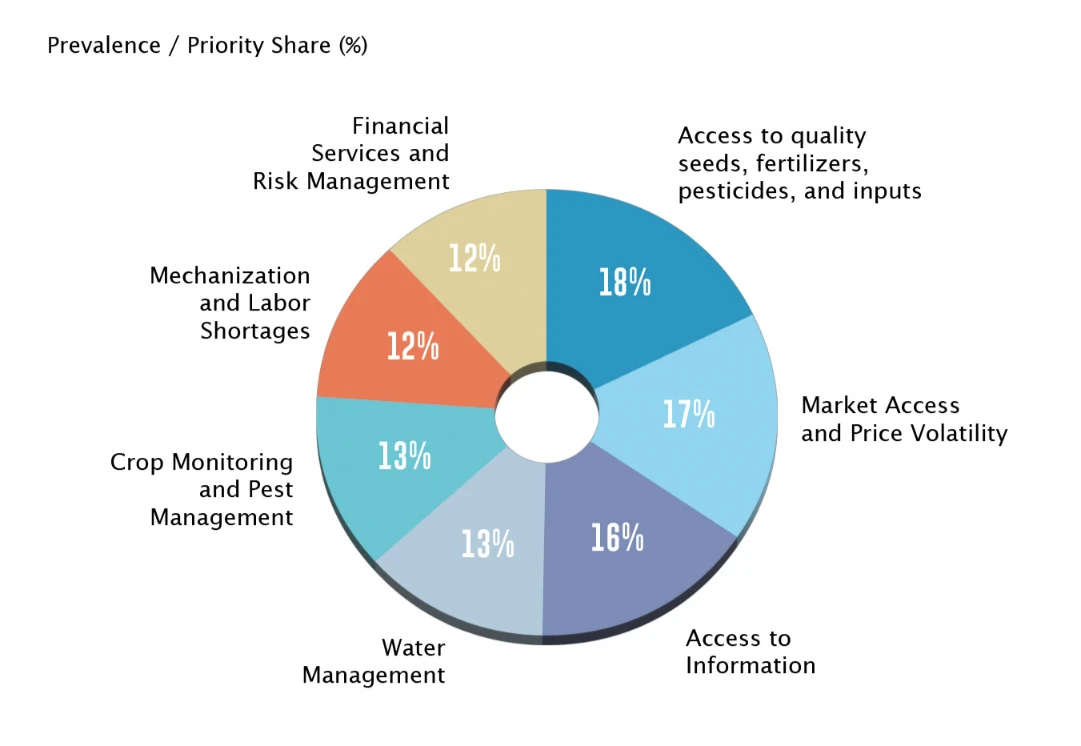
Market Evolution
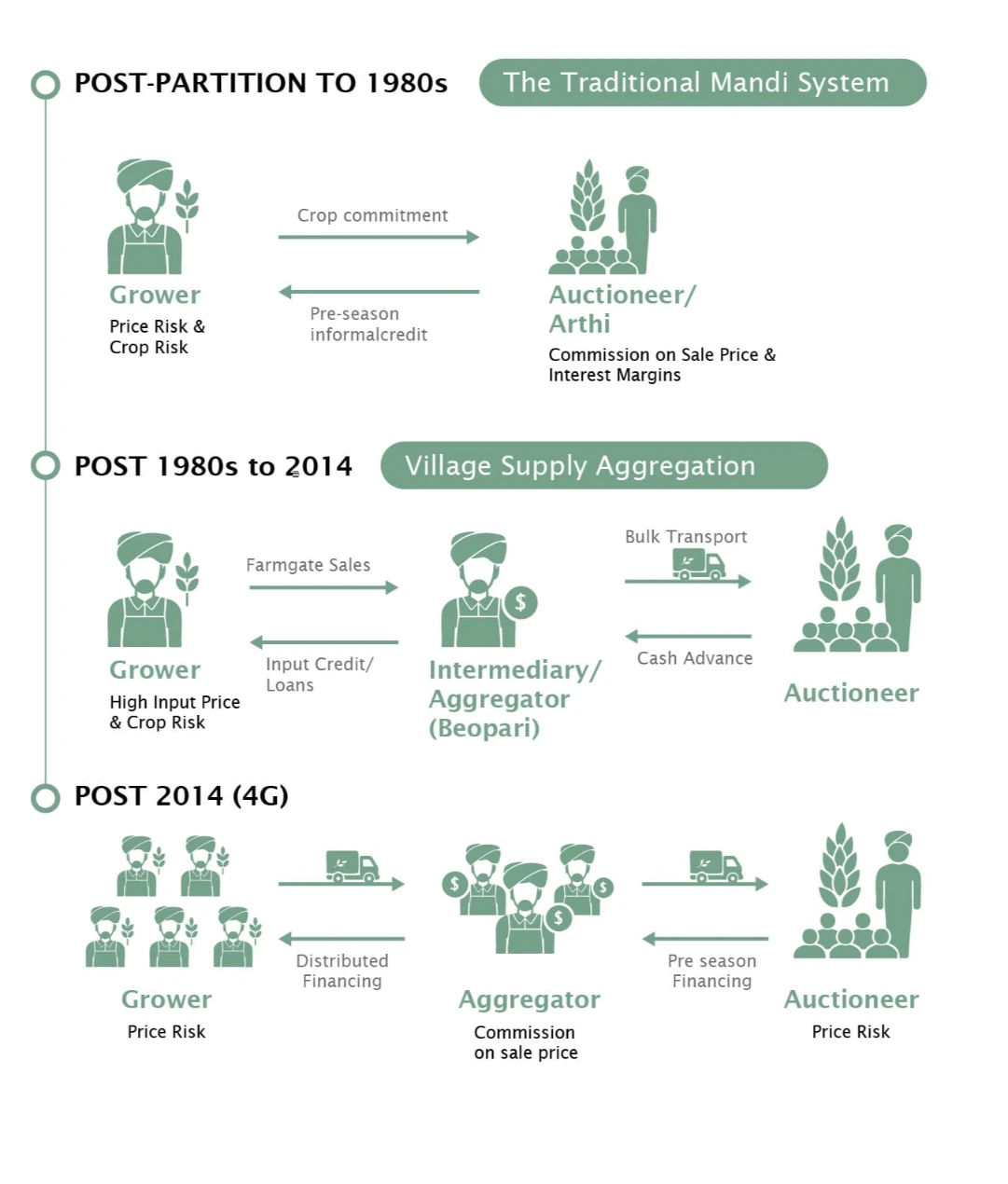
Markets that look chaotic often have a logic that only becomes visible over time. Pakistan’s banana supply chain is a case in point.
Before the 1980s, many farmers sold directly into urban wholesale markets. As production volumes expanded, rural aggregators emerged to consolidate produce from multiple farms, organise transport, and absorb the uncertainty associated with fluctuating prices. They made the supply chain more reliable and were compensated for the risks they assumed.
The market evolved again with the spread of 3G and 4G mobile internet after 2014. Price information, once concentrated inside wholesale markets, became available to anyone with a smartphone. Farmers could compare prices across cities in real time. A Facebook Live auction of melons in Peshawar could influence negotiations at a farm nearly 1,500 kilometres away in Thatta the following morning, something we experienced firsthand in 2022.
As information asymmetry declined, the role of intermediaries changed rather than disappeared. Rural aggregators gradually transferred much of the price risk downstream. Urban commission agents increasingly evolved into principal risk-takers and providers of working capital. Their role became financially more sophisticated, not less.
The startups saw the structure that existed in 2020. They did not see the decades of institutional evolution that had produced it.
Beyond Agritech: Where Pakistan’s Productivity Problem Actually Lies
The broader lesson extends well beyond venture capital.
Agriculture employs roughly one-third of Pakistan’s labour force while contributing only around one-fifth of GDP. That gap is a symptom of low productivity rather than excessive intermediation. If transaction costs inside wholesale markets were the primary constraint, removing intermediaries should have generated substantial gains in farmer incomes and consumer prices. The evidence suggests otherwise.
Pakistan’s larger agricultural constraints lie elsewhere: low yields, fragmented landholdings, weak seed genetics, inefficient irrigation, inadequate mechanisation, limited cold storage, inconsistent quality standards, and poor integration with export markets. These are production and productivity problems rather than distribution problems.
The distinction matters because it changes where capital should be deployed. Building another platform to replace commission agents addresses only a small part of the value chain. Investments that improve output per acre, reduce post-harvest losses, strengthen storage, expand agricultural finance, or enable exports are far more likely to raise incomes and improve competitiveness over the long run.
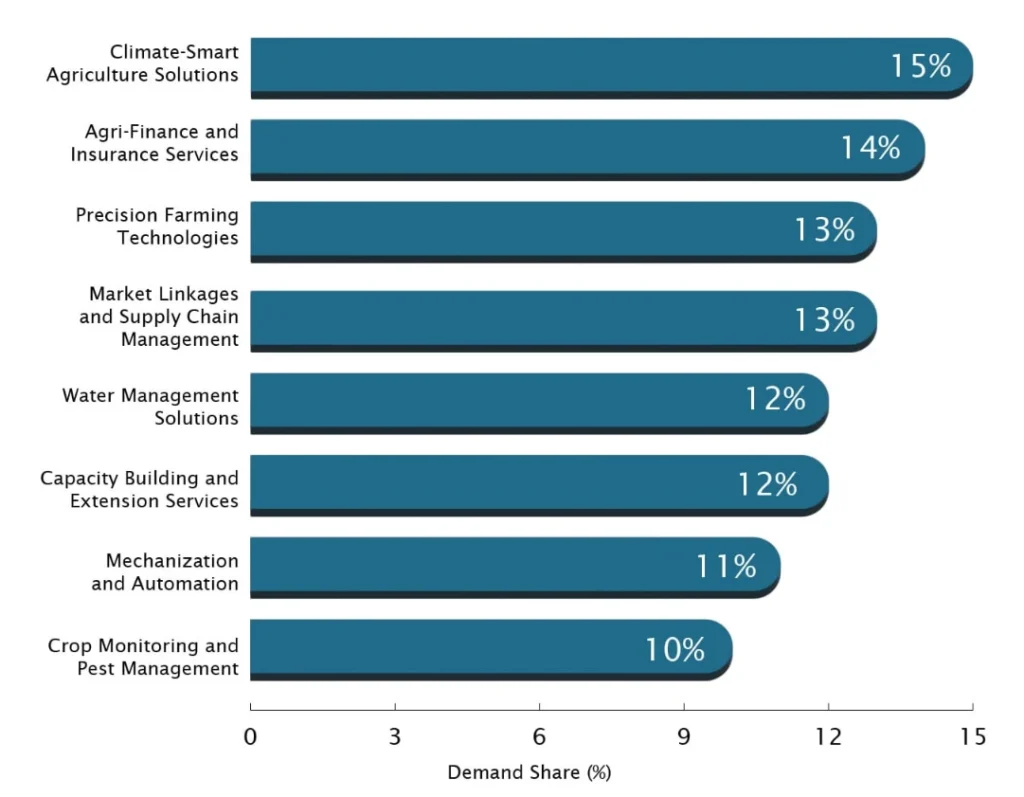
The lesson is not that technology has no role in agriculture. It is that technology is most valuable when it complements institutions that already work rather than attempting to replace them without understanding why they exist. A recent P@SHA study also finds a rising trend in agritech firms targeting areas fixing fundamental problems faced by farmers.
Current Market Demands for Agri-Tech Solutions in Pakistan
Parting Thoughts
The founders were among the brightest entrepreneurs in Pakistan and had previously built and scaled successful businesses. The failure was analytical rather than operational. The market was interpreted as archaic because it looked archaic. The noise, the informality, the absence of software, and the reliance on relationships were mistaken for evidence of inefficiency. They were not the same thing.
The supply chain that moves Pakistan’s food every day has quietly solved difficult economic problems for decades. It allocates credit where formal finance is absent. It discovers prices in real time. It absorbs volatility, minimises spoilage, and coordinates millions of transactions without sophisticated technology or central planning.
It solved those problems long before venture capital arrived.
That deserved more respect.
Contributor: Ali Wafa




2 thoughts on “Pakistan Agritech’s $15 Million Misread”
Pakiatan banana business has a big potential to grow a lot and improve the technology they have at present. I was so glad that I shared my knowledge & experience with Indus Acre company showing them many steps to improve quality & production. I consider its time to go more steps beyond by changing the way to sell bananas in bunch to a well packed it in a cardboard. Will fell happy if I see Pakistan banana compiting in Asia market against bananas from America & Philippines and delivering consistent QUALITY & VOLUME.
Thank you Felix – we have learned immensely from your global experience & are grateful for your support!
Best
Sanakhawan