ABCs of Pakistan’s Economy
Only after readers understand the ABCs of Pakistan can they start to realize what is required to change the future prospects of the country. This belief is what Macro Pakistani was built on in 2020, and it’s what Brand Nib has carried forward since taking the platform on in 2026. We exist to provide a simple understanding of economic facts and frameworks. Once readers understand the macro overview of their daily problems, they make more sense of the news around them.
Most readers today are stuck between two bad options: the sensationalism of traditional news media, or specialized writing that regurgitates technocratic lingo. We built Macro Pakistani, and now MP Insider, to be the alternative, telling you all you need to know about the economy through bite-sized, digestible pieces, curated to cut through the noise.
One thing we’ve said repeatedly, across both eras of this platform, is that low investment and low productivity growth sit at the root of most of Pakistan’s economic problems. For anyone aiming to understand the Pakistani economy, that’s still where to start.
All you need to know about the economy
Economic growth is driven by growth in labor, capital or total factor productivity (TFP). TFP can be interpreted as how smartly factors of labor and capital are used. Therefore, it is the main determinant of long-term economic growth. Incidentally, in economic models, ‘A’ also denotes Total Factor Productivity.
Investment vs. growth in Total Factor Productivity (1990-2023)
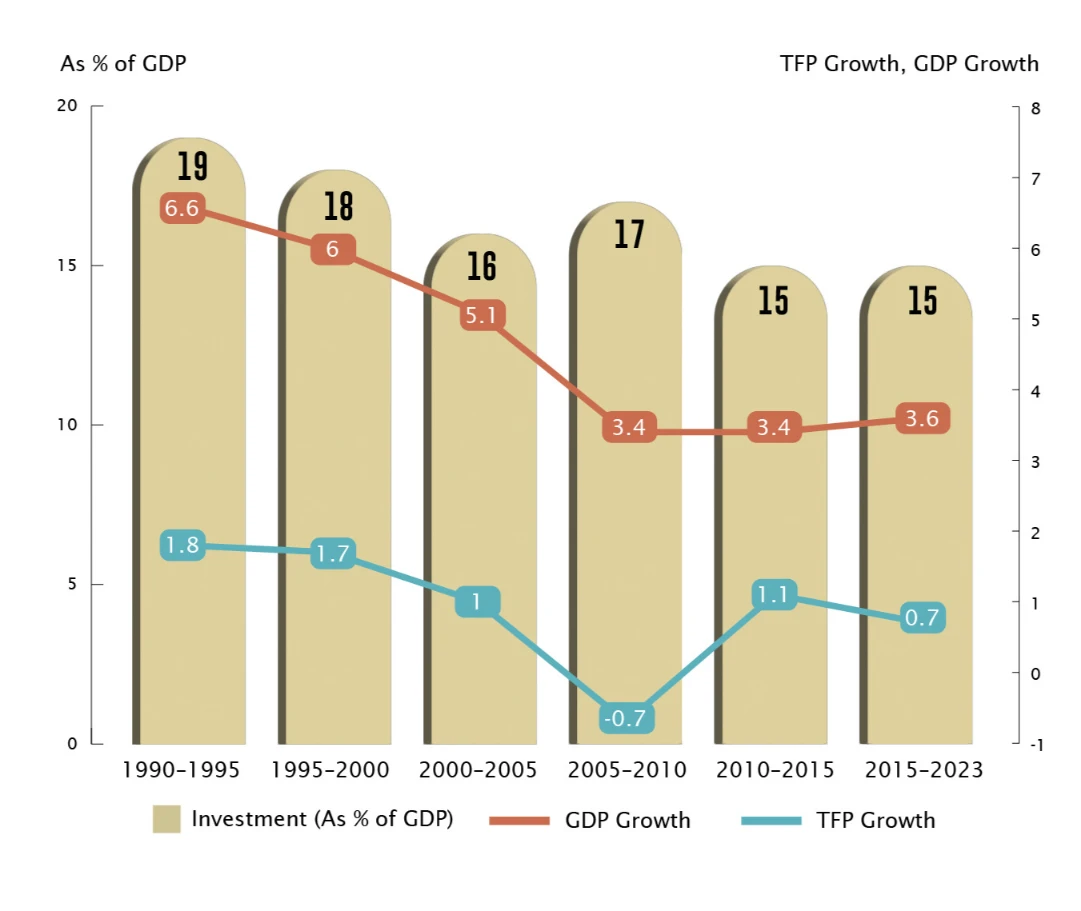
The graph shows that the highest economic growth (red line) in the last 50 years came about due to high investment levels (grey bar) and TFP growth (green line) in the 1980s. Since then, contribution of investment has fallen to less than 15% of GDP and growth has stagnated. According to PIDE, over 66% of Pakistan’s growth in the last 50 years has come about due to an increase in labor and capital inputs. That leaves around one-third of growth driven by TFP. This means, most growth has come about through an increase in resources (e.g. increased labor force) rather than making those resources more efficient. Hence, productivity has stagnated across sectors in Pakistan and the country has failed to achieve sustainable growth.
Another effect of low TFP is that Pakistani goods and services have become increasingly uncompetitive in international markets. This has led to low export growth and forced Pakistan to go back to the IMF for support repeatedly. The way to increase competitiveness is clear. Invest in institutions, infrastructure, and information and communication technology (ICT) to create an enabling environment. Boost human capital and capabilities to have a productive labor market and foster an innovation ecosystem. However, Pakistan continues to lag other low-middle income countries across most of these indicators.
Global Competitiveness Index 4.0 2019 edition (rank out of 141)
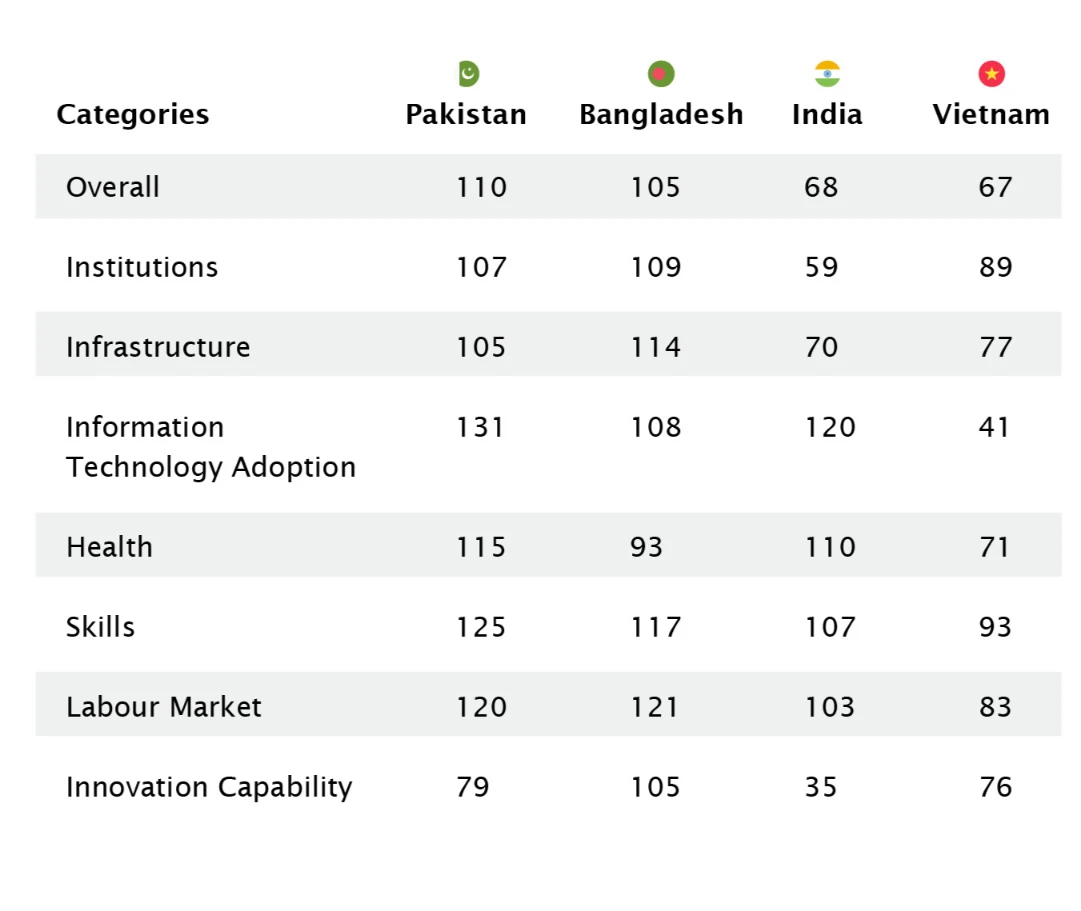
Note: The WEF paused the Global Competitiveness Index after this edition and has not revived it since, so the 2019 ranking remains the last formal comparison of its kind. It is still the most useful cross-country benchmark available, even if it is not being refreshed annually anymore.
Bite-sized, digestible pieces
To make these comparisons easier to understand, instead of comparing to all the other countries mentioned above, let’s benchmark Pakistan against Bangladesh. Institutions and infrastructure are poor across both countries but where Bangladesh stands out is its higher focus on ICT adoption, health and skills. It invested in its people and developed its human capital base to compete against the rest of the world. In Pakistan’s case, as we learned in an earlier post, a higher proportion of GDP is spent on the military as compared to health and education, as part of the annual budget.
Public expenditure on health and education vs. military (2020-25)
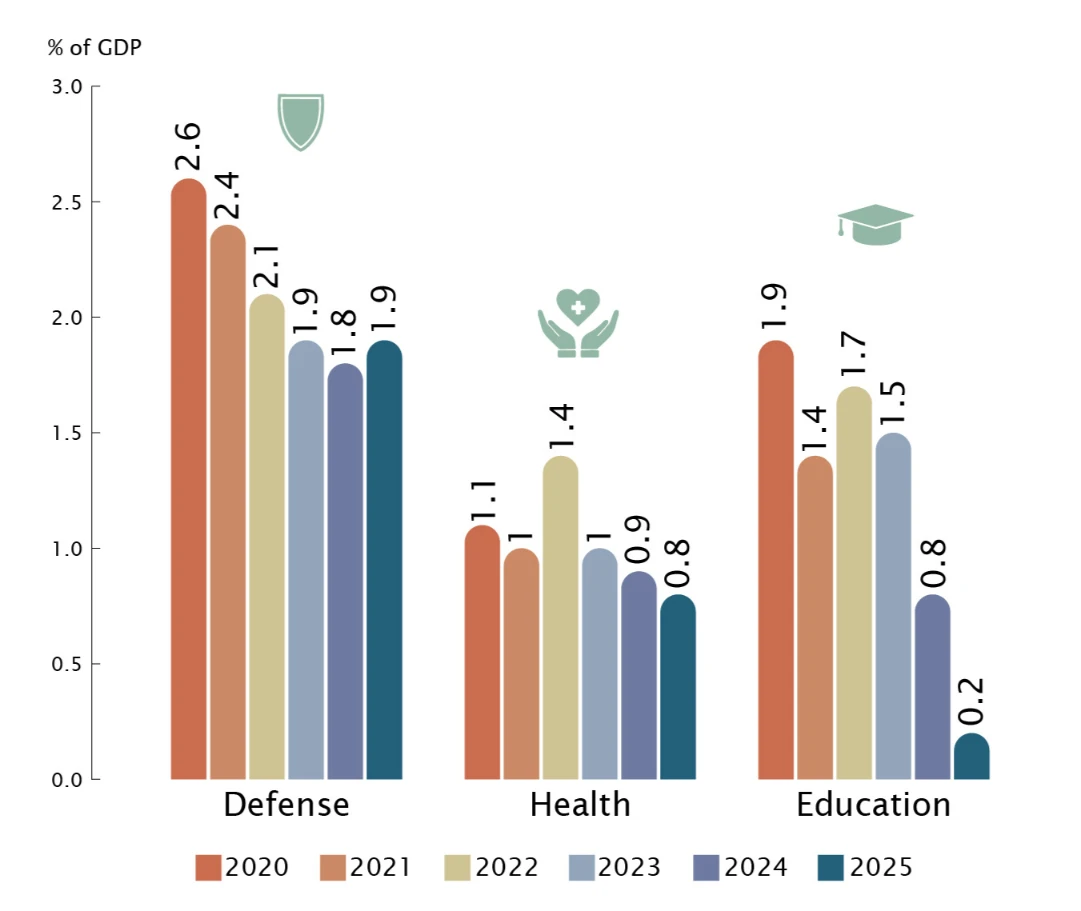
As Budget figures show, Pakistan has not only failed to prioritize investment in human development, it has also tried its best to understate military expenditures. While officially reported defense spending was 3% of GDP in 2019, military pensions, which make up an additional 0.7% of GDP, were reported under the civilian head.
This pattern has not eased in the years since. The FY2026-27 federal budget pushed defense spending past PKR 3 trillion for the first time, an 18% increase, while education and health continue to sit at around 2% and 1.3% of GDP respectively. The gap the dotted line and bars illustrate above has, if anything, widened.
Curated to cut through the noise
Mainstream media is noisy. If they try hard, audiences might be able to decipher the ‘what’ of a news story. The ‘so what’ however, is mostly missing. Even if we know the problems of Pakistan and what public officials are prioritizing, the reasoning behind is more often than not hard to find. At Macro Pakistani, we use in-depth data analysis and global benchmarks to clarify the ‘so what’. For example, most have heard of the Naya Pakistan Housing scheme. Some might even know that successive governments have tried to address the lack of low-income housing in Pakistan. In completing the ABCs of Pakistan, we will talk about the impact issues like housing have had on Consumers in Pakistan.
Private consumption of housing & household fuels in Pakistan vs. global benchmarks
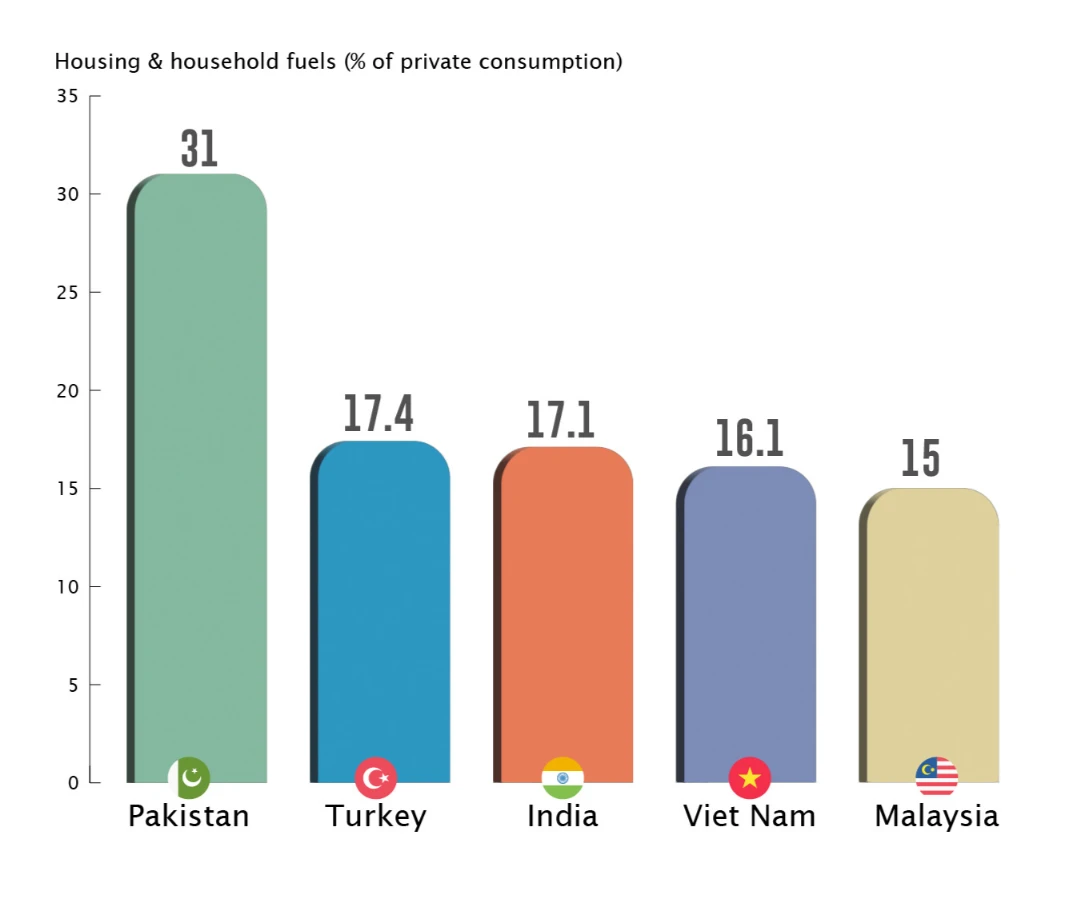
As Macro Pakistani has discussed before, consumers in Pakistan have to spend an outsized amount on housing and electricity in the country. Pakistan is a consumption driven economy and one of the biggest items private consumers spend on, is housing & household fuels. Because of failure of past governments in addressing issues with housing and energy, consumers in Pakistan have to spend almost twice as much as those in other countries. If you consume more, you save less of your income. If you save less, you invest less. That is how the cycle of low investment, low productivity, low income and lower standard of living perpetuates.
The Naya Pakistan Housing scheme itself is a good illustration of this failure to execute. The authority behind it, now folded into NAPHDA, has built a small fraction of the five million low-cost units originally promised, and much of what has been delivered has gone to government employees rather than the general public it was meant to serve.
This is the kind of gap between promise and delivery that Macro Pakistani exists to surface, in 2020 and now. Our long-term aim hasn’t changed: democratize information in Pakistan, and help channel the country’s high civic engagement toward a greater sense of responsibility and accountability. MP Insider is the next chapter of that work. We hope you’ll be part of it.
Original Author, ‘Faiz Ahmed’, analysis from the archive of Macro Pakistani.
Updated in 2026 by Macro Pakistani’s Head of Content Research, Sharmeen Sajjad.