Pakistan spent $507 million on 5G spectrum while 85% of its cell towers still run on infrastructure that cannot support it.
Pakistan’s March 2026 5G auction finally ended years of delays. Several months later, the licenses have been awarded, but the harder questions remain: can Pakistan actually build a commercially viable 5G network?
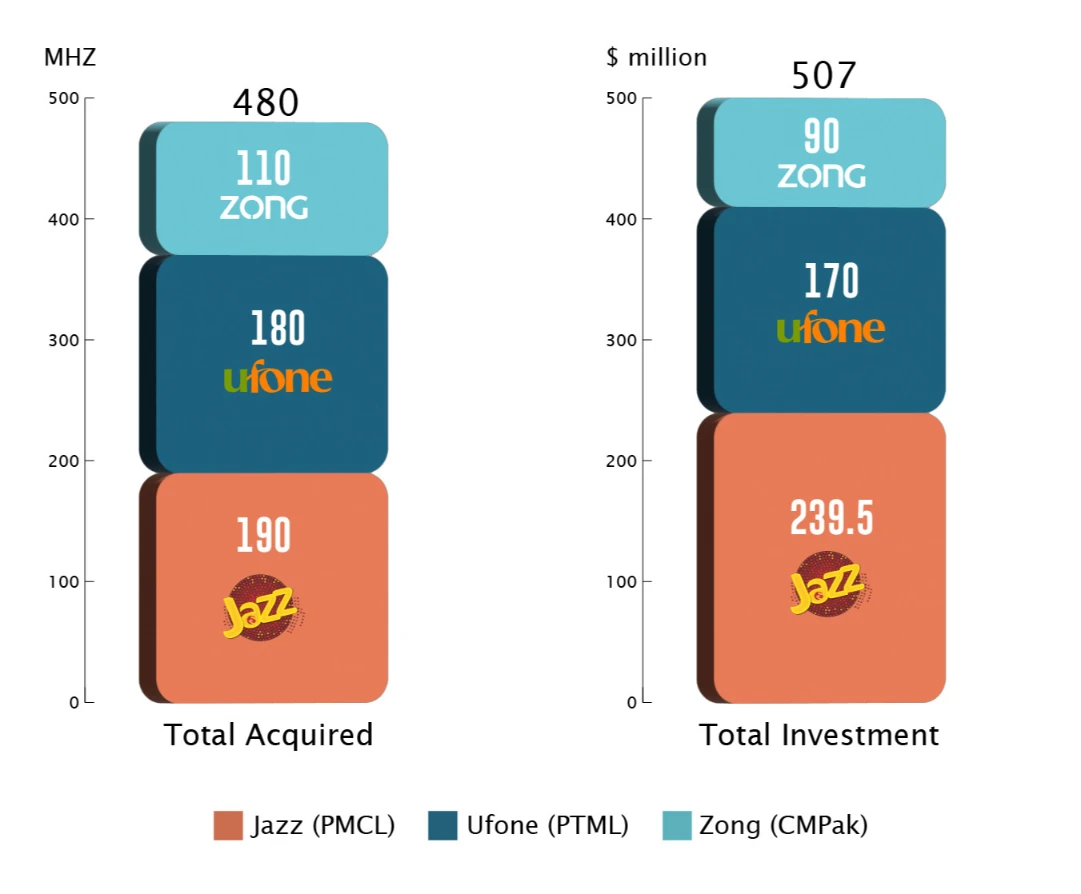
The big three: Jazz, Zong, and Ufone walked away with 480 MHz across six frequency bands, and the government collected half a billion dollars (which is less than the $1.11 billion it received during the 3G/4G combined auction in 2014). On paper, it is still a clean win, but in practice, it is the start of a very long road.
This piece looks at what the auction actually delivered, where Pakistan’s infrastructure falls short on fibre backhaul and device affordability, and why the investment climate remains a serious obstacle. It also covers what the technology could realistically do for agriculture, healthcare, and the broader economy once the foundational work catches up.
5G Auction: the Wins
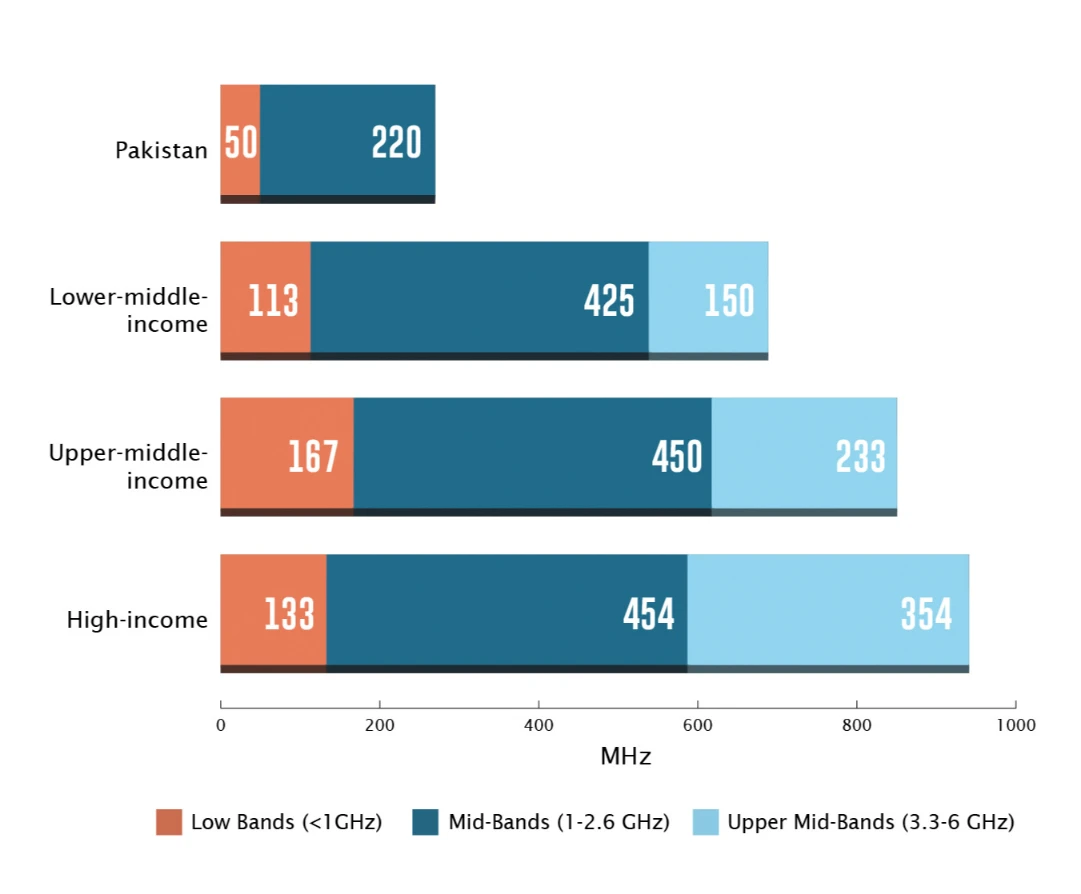
Pakistan’s networks were suffocating as, between 2022 and 2025, roughly 46 million new subscribers joined without any matching increase in spectrum. The country had just 274 MHz total, less than half of Bangladesh’s allocation and about a quarter of India’s. Congestion for all users and low internet were the predictable results. The auction nearly triples usable spectrum with Jazz securing around 200 MHz, Zong 150 MHz, and Ufone 130 MHz. The frequency mix is quite sensible, ranging from high-coverage brands such as Jazz to speed-focused brands like Ufone (including Telenor and ONIC). The 700 MHz low-band covers wide rural areas and penetrates buildings, while the 3500 MHz mid-band is where most countries are building their 5G capacity because it balances range and throughput well.
Yet the hurdle remains: the physical infrastructure to carry those signals, the devices that 99% of Pakistanis do not own yet, and the investment environment that makes building all of this genuinely hard to justify.
Regional Comparison
Where Pakistan stands versus its neighbours:
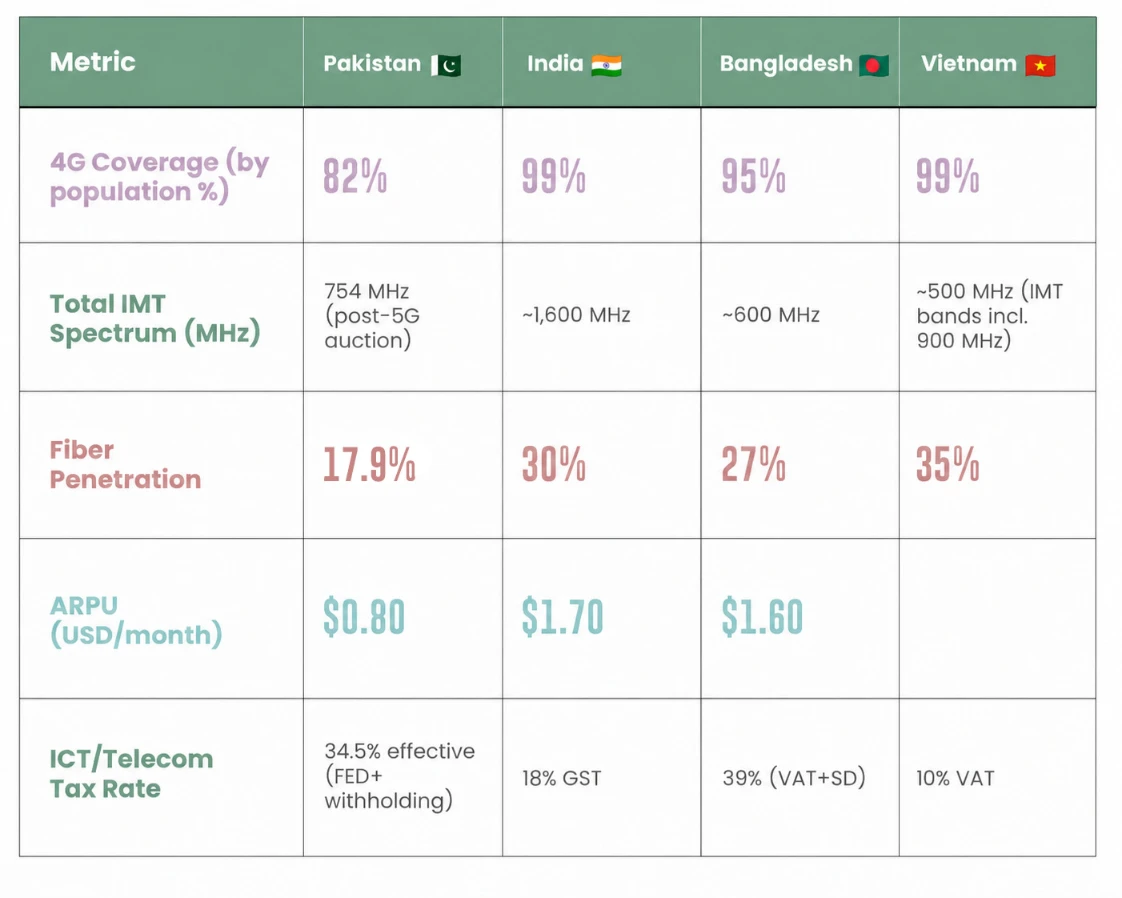
Vietnam is worth pausing on, as a lesson to heed, as its 2023 5G auction failed because reserve prices were too high and operators could not make the numbers work. The government responded by cutting spectrum costs by up to 90% and subsidising 15% of base station equipment. By 2024, Vietnam had a working 5G rollout. Pakistan’s own auction delays, driven by litigation, dollar-pegged floor prices, and operator pushback, had the same shape as Vietnam’s pre-reform period.
The Infrastructure Bottleneck: Fiberization
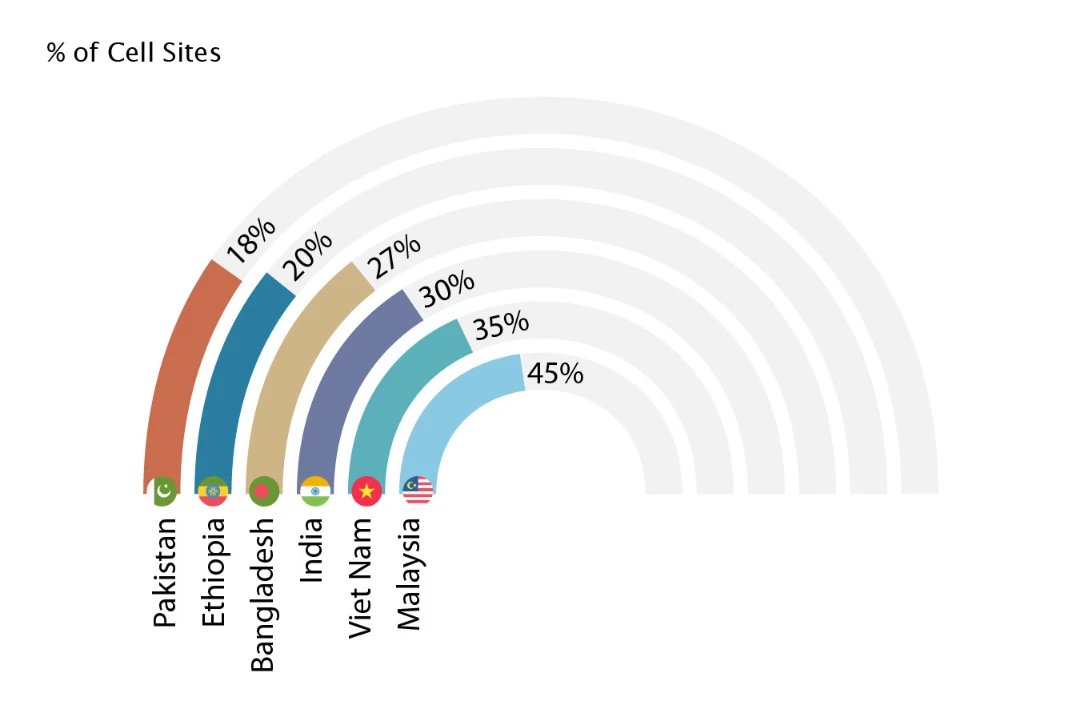
Pakistan’s current situation has moved but not by much. Fiberization now sits at 17.9%, up from 14.8% at auction time. Jazz leads at 22%, Zong at 19%, Telenor at 16% before its merger into Ufone, and Ufone itself trails at 9%. The other roughly 82% of towers still run on microwave radio links, point-to-point wireless bridges that worked for 4G but hit a hard ceiling on 5G traffic loads.
5G Bottleneck: Fiberization
Fiber Penetration across Countries
Opening Pakistan’s 5G Runway
Final Auction Results (March 10, 2026), Spectrum Acquired and Investment
5G performance depends as much on what happens underground as in the airwaves. When a signal leaves a tower, it needs to reach the operator’s core network fast. That journey is called backhaul, and the medium it travels through matters enormously. For faster speeds, fibre-optic cable is the gold standard: a strand of glass thinner than a human hair can carry terabits per second with latency in fractions of a millisecond. 5G Standalone, the full-spec version of 5G, requires backhaul bandwidth above 10 Gbps per site and round-trip times under 5 milliseconds, speeds that can only be met by fiber.
Pakistan’s current situation is quite dismal as only 14.8% of cell sites are connected to fiber. The other 85.2% use microwave radio links, which are point-to-point wireless bridges. Microwave links worked fine for early 4G but they have a fixed capacity ceiling, degrade in bad weather, and cannot scale to 5G traffic loads. This infrastructure is unable to withstand Pakistan’s data consumption needs which grew from 2,493 petabytes in 2018-19 to 10,850 petabytes in 2022-23, a fourfold increase in four years. Secondly, the latency issue is not abstract. One of 5G’s three core capabilities, ultra-reliable low-latency communications (uRLLC), targets 1 millisecond end-to-end. That is the threshold for remote surgical robotics, autonomous vehicle control, and real-time industrial automation. Microwave links introduce latency measured in tens of milliseconds across multiple hops. Without fiber, Pakistan gets faster consumer downloads in city centres, but not much beyond that.
What was stopping Pakistan from laying more fibre has partly moved. Right-of-way fees, the annual per-metre charge that made India’s one-time ₹1/metre model look sane by comparison, have reportedly been abolished across all provinces, according to IT Minister Shaza Fatima’s statement to the Senate IT committee in June. This reform has been crucial to the expansion of digital infrastructure in the country. It came faster than expected, and messier. The vehicle for it, the Telecommunication Reorganisation Amendment Bill 2026, passed the National Assembly on June 11 and triggered a separate fight over a different clause: one that lets operators access private property for towers and fibre, backed by fines up to Rs 50 million for refusal. The IT ministry has had to publicly deny the bill allows forced entry onto private land. So the fee problem may be solved but the access problem is now a live property-rights dispute working through the Senate.
Another development in recent times has been the adoption of E-Band spectrum. Operators picked up this option in July: E-Band spectrum for high-capacity wireless backhaul, assigned specifically so towers in fibre-dark areas can get 5G-grade backhaul without waiting for cable in the ground. It’s not a fibre substitute for the low-latency use cases this piece cares about; remote surgery and industrial automation still need fibre’s sub-5ms round trip. But it does let operators light up more towers faster while fibre catches up, which changes the “nothing happens until fibre reaches 50%” timeline somewhat.
The Device Problem
Suppose the above problem is solved by massive investments, still most Pakistanis could not access 5G from their phones since less than 1% of handsets in the country support it. Roughly 90% of devices assembled locally are barely 2G or 3G compatible.
This is more than a consumer preference issue or an affordability decision. Imported smartphones face combined duties and taxes of up to 40%, including the PTA tax originally designed to protect local assembly. A budget 5G phone retailing globally at $150 lands in Pakistan at around $210. For a country where the average monthly ARPU across the entire user base is $0.80 and the IMF estimates 89% of the population cannot afford internet access, that price point is out of reach for most families. To ease this pressure, operators have tried instalment financing schemes. They have mostly stalled because there is no cross-network system to prevent defaults. A user can take a subsidised phone from Jazz, stop paying, and switch to Zong with no record following them. Without a regulatory fix, operators cannot offer financing at the scale needed to shift device penetration meaningfully. The government is promoting a Digital Pakistan agenda while maintaining a 40% tax on the hardware required to access it, thus maintaining the resistance to meaningful change.
Pakistan’s Bandwidth Crunch
Spectrum Capacity Comparison (Pre-2026 Auction)
The Investment Gap
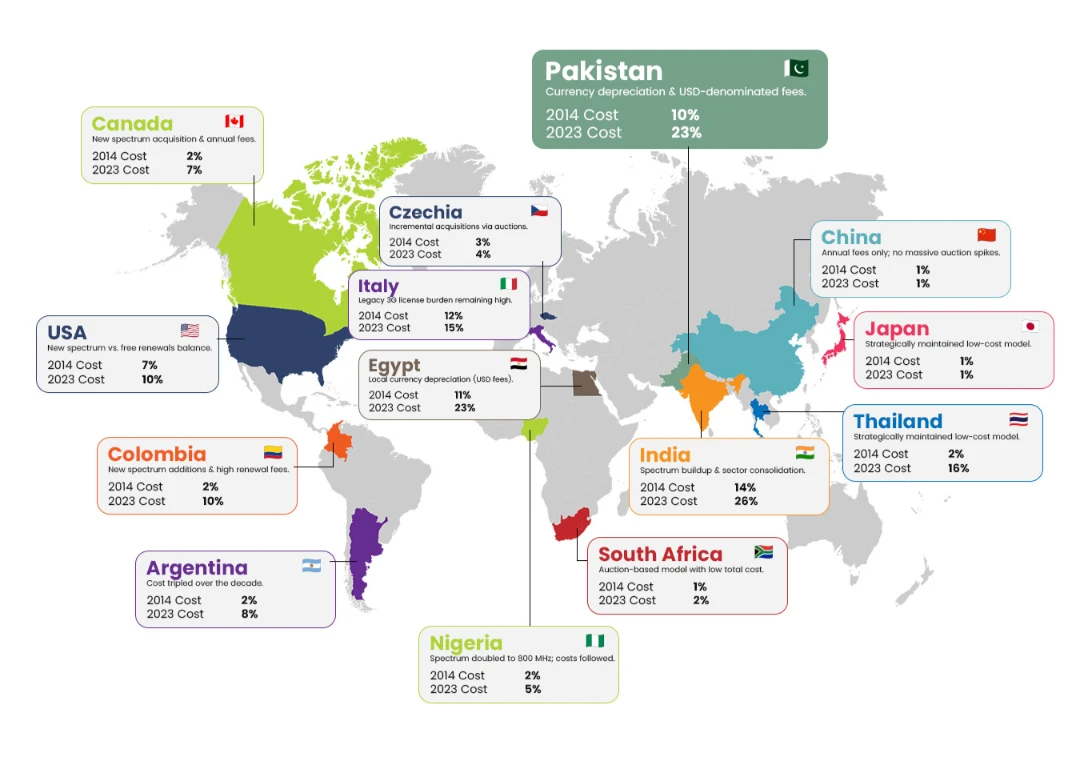
At the end of the day, it comes down to investment. Baseline deployment cost for a country like Pakistan runs between $3 billion and $8 billion. Extending coverage to rural and difficult terrain adds another 20 to 35% on top. Pakistan’s economics make that investment hard to justify. ARPU is $0.80 per month, ten times below the global average of $8. Combined ICT taxes reach 34.5%, one of the highest rates anywhere. Spectrum prices are pegged to the US dollar, so every time the rupee falls, and it dropped 165% between 2017 and 2024, the effective cost of licenses rises automatically for operators earning in local currency. The result is obvious: net FDI in Pakistan’s digital infrastructure fell from $1.67 billion in 2021-22 to $750 million in 2022-23, and it has struggled to recover since. Telenor exited the market technically, reducing competition. Operators have faced difficulties opening Letters of Credit just to import equipment for basic upgrades. The money needed for a meaningful 5G buildout is not currently flowing in, and there is no potential solution readily available either.
The Telecom Cost Trap
Global Comparison: Spectrum Cost as % of Revenue (2014 vs. 2023)
What to Expect
With the status quo approach to 5G availability, there is not much we can expect yet. The technology can theoretically hit 20 Gbps, but Pakistani trials recorded 1.685 Gbps… There is a stark difference between the theory and reality; instead, the PTAs’ own targets are more honest:
- 2028: 50 Mbps median 5G download
- 2030: 75 Mbps median
- 2035: 100 Mbps median
Current 4G median speeds in congested urban areas often fall below the PTA’s existing 20 Mbps 4G target, a direct result of the spectrum shortage the auction was designed to fix. Early 5G users in Islamabad and Karachi should see genuine improvement. For the rest of the country, completing reliable 4G coverage is the more immediate priority.
449 5G sites are live across 22 cities as of July, riding existing towers rather than new infrastructure. A PTA committee member warned that at the current pace, nationwide rollout may not finish until 2035, by which point the technology could already be outdated. That’s the regulator saying, on the record, roughly what our Substack piece argued in March.
Potential of 5G in Pakistan
The GSMA projects 5G adding $12.4 billion to Pakistan’s GDP by 2030, around 3 million jobs in IT and IoT, and a 20% increase in IT exports to over $5 billion by 2028. These numbers are plausible if 5G achieves broad adoption. That is quite a large if.
Agriculture is the strongest near-term case. The sector accounts for around 10% of GDP. 5G-enabled IoT sensors for precision farming, monitoring soil moisture, temperature, and nutrients in real time, could increase crop yields by 20 to 25% and cut input waste significantly. Healthcare, cybersecurity etc are also valid use cases for 5G implementation, but they all depend on solving the fibre problem first.
Way Forward
The auction was one policy decision, while the conditions that have kept Pakistan’s digital infrastructure behind its neighbours are mostly still in place. A couple of immediate changes analysts consistently point to are:
- Right-of-way fees abolition amendment’s efficacy is under question. Since a badly drafted access clause could slow deployment through litigation and local resistance just as effectively as the old fee structure did.
- De-link spectrum pricing from the US dollar to remove exchange-rate risk for operators
- Cut the ICT tax rate to competitive regional levels and hold it there for at least a decade
- Reduce or remove import duties on 5G handsets, since 40% runs directly against a digital inclusion agenda
- Redirect Universal Service Fund spending toward device subsidies and rural fiber, not just tower construction
These are regulatory and fiscal decisions, and don’t require too much research & development on the part of the industry. Therefore, the track record on implementation of policies in Pakistan is the uncertain part.
The auction fixed the spectrum problem. That is real. But standing between today’s signed licenses and a future where a farmer in Sindh gets real-time soil data on his phone, or a patient in Balochistan connects to a specialist in Karachi, there is still a lot of unglamorous work left to do. The applications that make 5G worth the investment are not just consumer novelties, but rather structural improvements such as precision agriculture, which could lift crop yields 20 to 25% in a sector employing tens of millions. Remote diagnostics could reach districts where the nearest hospital is hours away. Smart manufacturing and logistics could make Pakistan’s IT export ambitions match its actual talent pool.
None of that follows automatically from a spectrum auction, instead it follows from fibre reaching 50% of cell sites, not 14.8%; from a 5G-capable phone costing what a family can actually afford, not $210 after a 40% import tax and from operators confident enough in the regulatory environment to commit multi-billion dollar plans over a decade, rather than watching FDI halve in a single year.
To answer the question this piece set out with: 5G is, for now, closer to a marketing story than a working technology for most Pakistanis. The spectrum auction will likely translate into better 4G speeds in urban areas, and that is not nothing. But the millions of dollars operators paid to acquire licenses have to be recovered somewhere. In an uncertain economic environment, with FDI falling and ARPU already at rock bottom, that cost will almost certainly land on current consumers rather than on the back of a broad economic transformation. The precision agriculture, remote surgery, and smart city applications are real possibilities. They are just not the reason operators bid at this auction, and they are not what pays the bills in the next five years.
Sources Consulted
- Shahzaib Abbasi, Inside Pakistan’s Largest Spectrum Auction, Data Darbar, February 9, 2026
- Asian Development Bank, Pakistan’s Digital Ecosystem: A Diagnostic Report, July 2025
- GSMA Intelligence, The State of 5G 2026
- World Bank, The Path to 5G in the Developing World, 2024
- GSMA, Unlocking Pakistan’s Digital Potential: Reform, Trust and Opportunity, August 2025
- GSMA Intelligence, Scaling 5G in Asia Pacific: the importance of wireless backhaul, 2022
- LSE Blogs, The politics and economics of spectrum: 5G in Pakistan, October 2023
- PTA, 5G Auction Guidelines, February 2026