Pakistan wants to join the AI race from near the back of the pack… does its material realities allow this ambition?
A year ago, Pakistan announced the allocation of 2,000 MW of electricity for AI data centres and Bitcoin mining, positioning the initiative as a way to monetize surplus electricity, attract foreign investment and expand the digital economy. Since then, the global race for AI infrastructure has accelerated dramatically. According to UN Trade and Development (UNCTAD), data centres accounted for more than one-fifth of the value of all global greenfield investment projects in 2025, attracting over US$270 billion in announced investment. For the first time, investment in telecommunications, driven largely by AI data centres, surpassed renewable energy.
This shift presents Pakistan with a genuine opportunity. Yet the global experience suggests that AI infrastructure is no longer a competition based solely on low-cost electricity. Countries attracting large-scale investment have paired energy availability with reliable transmission networks, high-speed digital connectivity, predictable regulation and strong investor confidence. Emerging economies such as Malaysia and India have followed this sequencing, developing broader digital ecosystems before positioning themselves as regional AI infrastructure hubs. Pakistan, by contrast, enters this race with only 31 commercial data centres, compared with 296 in India and 114 in Malaysia. The gap is less about ambition than ecosystem readiness.
The principal constraint is not electricity alone, but the interaction between electricity, water and infrastructure. While Pakistan allocated electricity for AI development, data centres consume far more than power. A conventional 1 MW facility may require around 26 million litres of water each year for cooling, and the largest AI campuses now operate at hundreds of megawatts. This changes the policy debate from one of surplus electricity to one of resource prioritisation. As AI infrastructure expands globally, countries are increasingly planning energy, water and digital networks together rather than treating them as separate sectors.
This does not diminish Pakistan’s AI ambitions, but it does raise an important strategic question. Should the country compete for large hyperscale AI campuses, or pursue a more targeted strategy centred on sovereign AI infrastructure serving domestic businesses, government agencies, universities and regional cloud demand? Pakistan’s first sovereign AI cloud, supported by approximately 3,000 enterprise-grade GPUs, suggests that such a pathway is already emerging.
Ultimately, Pakistan’s success in the AI economy will depend less on how much electricity it allocates and more on whether it can provide the dependable infrastructure that global investors expect. The next phase of policy should therefore focus not only on attracting AI investment, but on building the physical and digital foundations that allow it to endure.
Pakistan Wants to Join the AI Race from Near the Back of the Pack
Number of data centers worldwide as of June 2026 by country
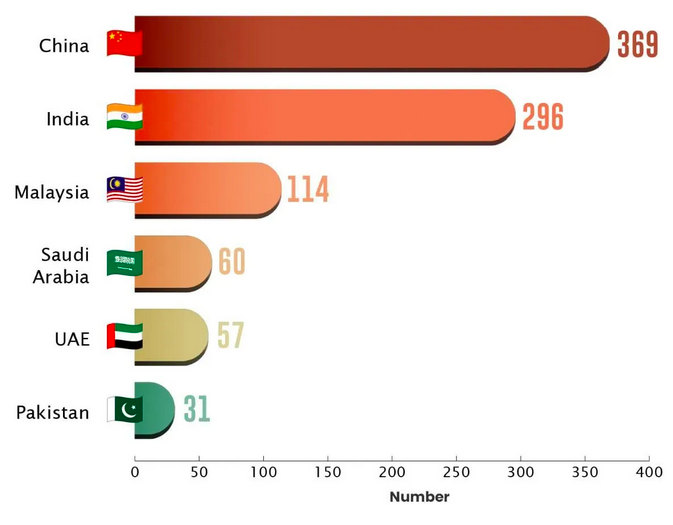
Source: Cloudscene, Statista