Why Pakistan’s ‘EV plan’ needs more than cheap cars and more chargers?
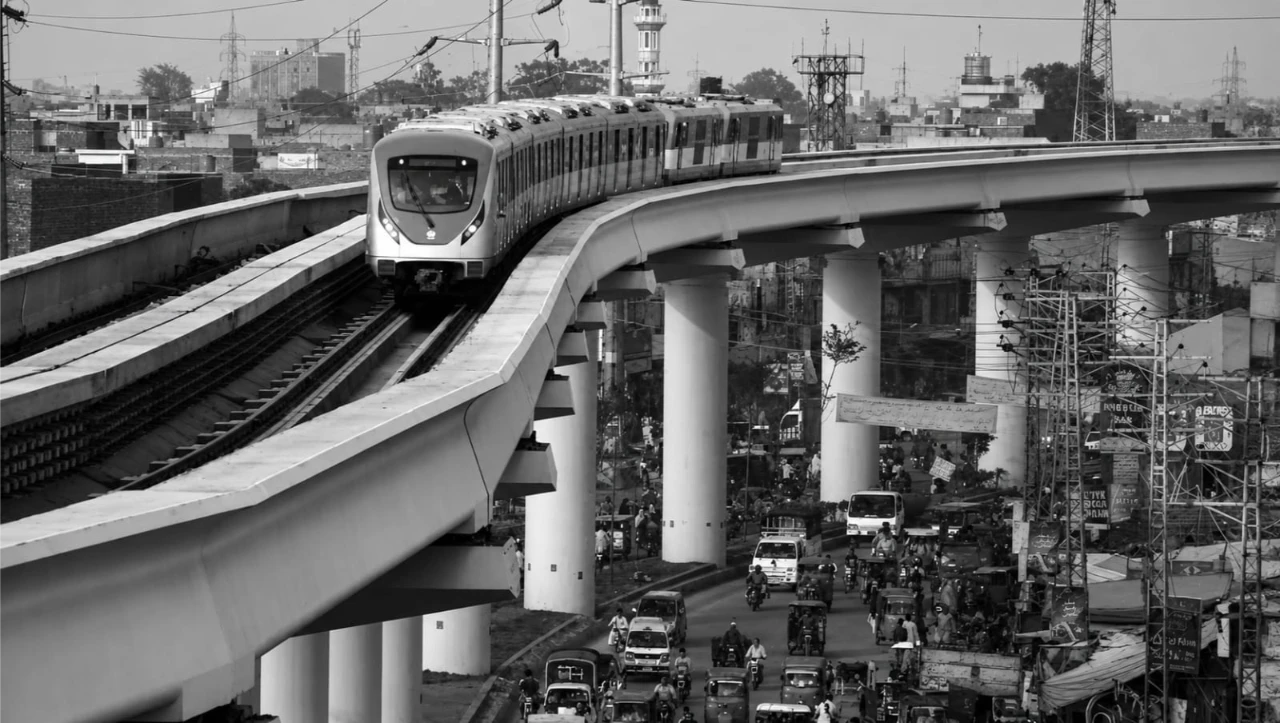
Pakistan’s ambition to accelerate electric vehicle adoption has largely been framed around vehicle costs, charging infrastructure, and consumer uptake, yet a critical part of the equation remains largely absent from the discussion: the transmission network that must deliver electricity to future charging demand. The omission is striking because Pakistan already possesses surplus generation capacity as well as major transmission assets designed to move power across the country. The 4,000 MW Matiari-Lahore HVDC transmission line, one of the largest investments in the national grid, transferred an average of just 1,397 MW in FY2024-25, operating at roughly 35% of its capacity. At the same time, congestion elsewhere in the network continued to restrict the movement of lower-cost electricity to major demand centres. This disconnect points to a broader challenge facing Pakistan’s transport electrification agenda.
If Pakistan cannot fully utilise a transmission line capable of moving 4,000 MW today, what happens when thousands of new EVs begin drawing power from the same network tomorrow?
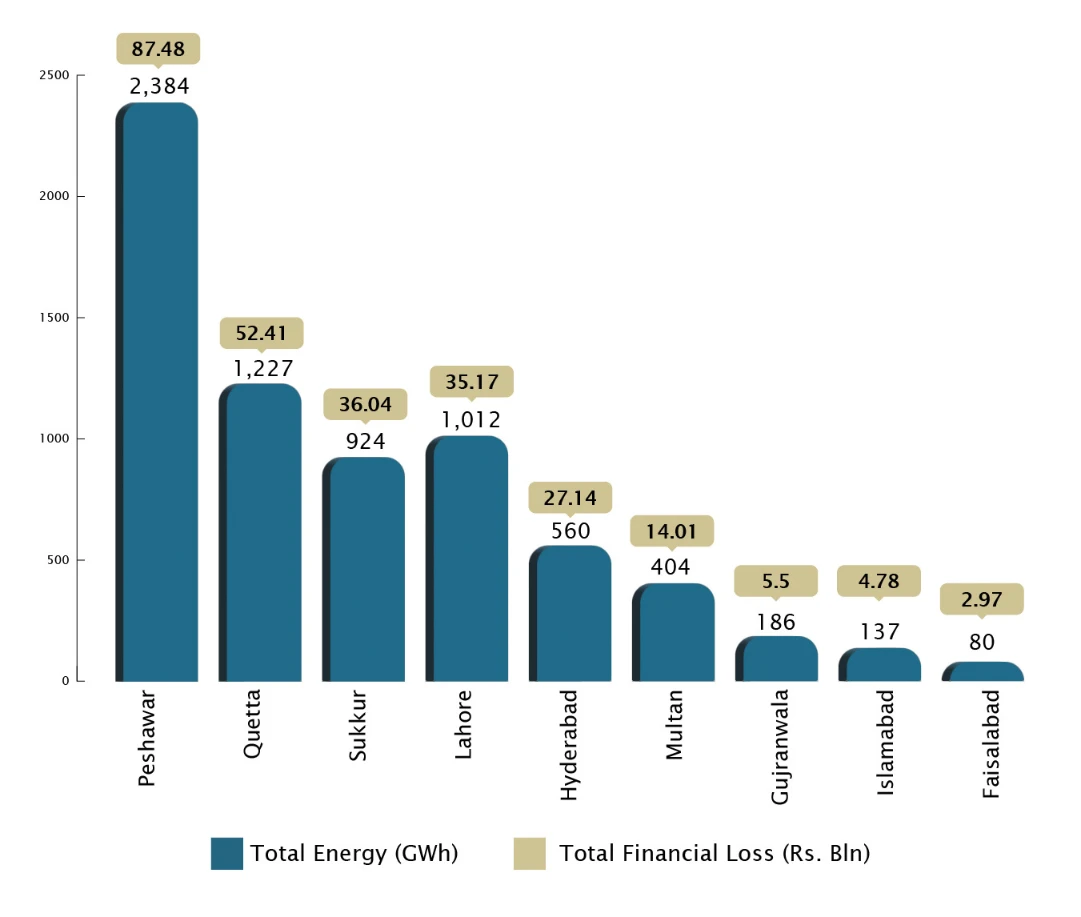
Pakistan’s Grid Losses Are Concentrated Where Reliability Is Already Weakest
Energy lost or curtailed and financial loss for top 10 DISCOs FY24-25
Most of Pakistan’s new electricity comes from the south
Part of the answer lies in the geography of Pakistan’s power system and the infrastructure built to overcome it. Over the past decade, successive investments concentrated new generation capacity in southern Pakistan, including coal-fired plants at Port Qasim and Hub, wind projects across Sindh’s wind corridor, and utility-scale solar developments. The transmission system is supposed to convert that geography into usable electricity. Pakistan’s grid data, however, points to a system that has expanded unevenly.
The backbone of the grid is shrinking
Between FY2020-21 and FY2024-25, Pakistan added nearly 1,750 circuit kilometres of high-voltage transmission lines. It also expanded the regional layer of the grid, with 220 kV transformation capacity rising by 55% from 25,770 MVA to 39,930 MVA. Over the same period, however, transformation capacity at the 500 kV level declined by 13%, from 30,610 MVA to 26,700 MVA. In effect, the secondary transmission layer expanded while the highest-voltage AC backbone, the part of the system responsible for moving bulk power across long distances, became more constrained.
A Bigger Grid With a Weaker Core
National Grid Company network, FY2020–21 to FY2024–25
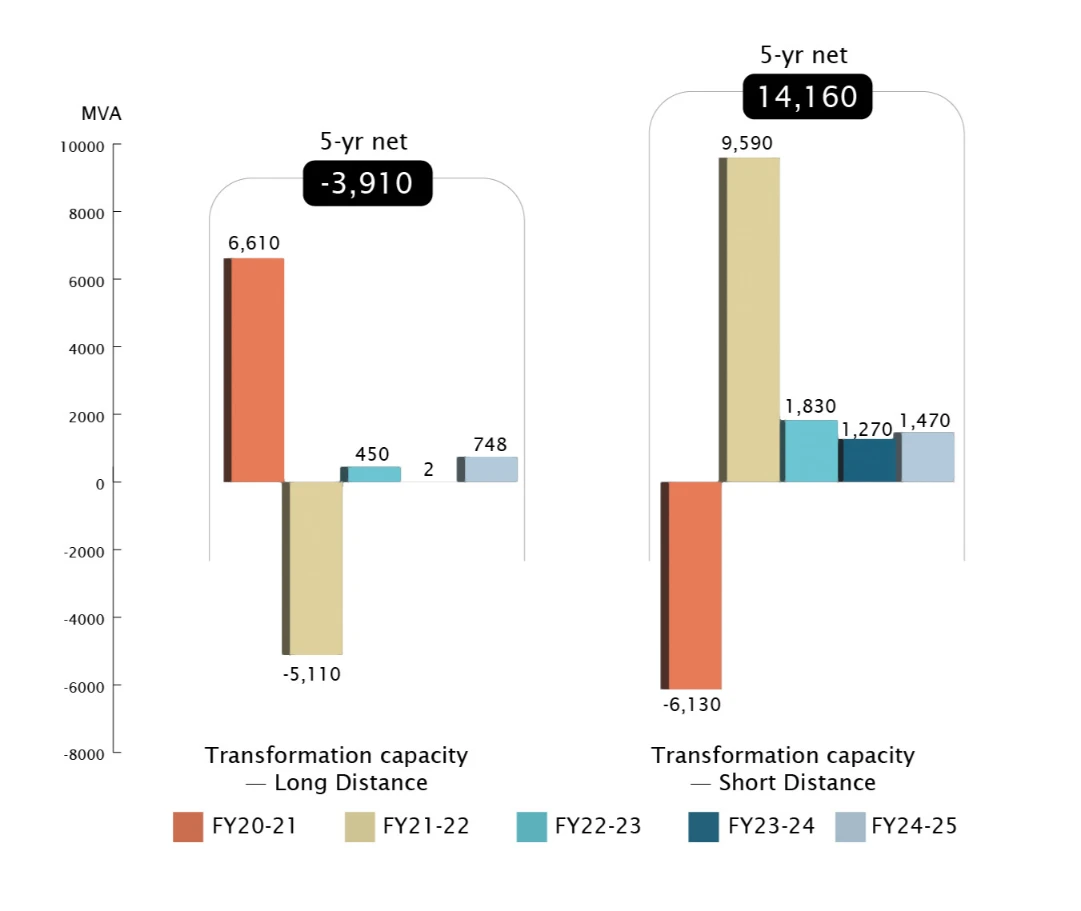
That divergence matters because it changes where the bottleneck sits. The power system can have enough generation, a larger network, and still fail to move electricity efficiently from where it is produced to where it is needed. NEPRA’s 2025 report places Non-Project Missed Volume at Rs. 13.29 billion in FY2024-25, which shows the potential generation that could not be dispatched because of grid constraints, scheduled maintenance or other system issues. The same report identifies inadequate transmission infrastructure and poor grid connectivity as major contributors to this unused potential. In practical terms, Pakistan is not only paying for capacity that is underused; it is also paying for the consequences of a system that cannot always absorb cheaper power when it is available.
EVs will intensify this problem because charging demand will not arrive as a smooth national average. It will arrive in clusters. Private vehicles will charge in the evening, commercial fleets will charge on fixed operational schedules, and intercity mobility will depend on a limited number of high-output highway charging corridors. A group of 50 kW or 150 kW fast chargers at a weak node resembles a concentrated commercial load placed on a system that may already be operating close to its limits.
Hyderabad’s grid fails thousands of times a year
The warning signs are already visible in grid-quality data. In FY2024-25, NGC recorded 107,012 voltage violations under normal operating conditions and another 563 under N-1 conditions. The burden is also geographically uneven. Hyderabad alone accounted for 69,214 normal-condition violations, followed by Lahore at 17,875 and Multan at 13,819. These are not abstract engineering statistics. They point to the same kinds of locations where EV demand is likely to concentrate: industrial belts, urban load pockets, agricultural demand centres and transport corridors. For households and businesses, poor voltage quality means unreliable supply and damaged equipment. For EV charging, it means interrupted sessions, higher equipment-protection costs and a greater need for backup systems that can raise the real cost of charging beyond the headline tariff.
Many transformers are already overloaded
The stress is not limited to voltage quality. In FY2024-25, 136 of NGC’s 288 power transformers were loaded above 80%, including 41 of 48 transformers at the 500/220 kV level. This is crucial for EVs as they require capacity at the right voltage level, in the right location, at the right time. A national surplus does not help a charging hub if the nearest transformer is already close to its operating limit. Nor does a public charging tariff solve the problem if the upstream network cannot reliably support the load.
Before EVs Arrive, the Transformers are Already Overloaded
Number of transformers by load status
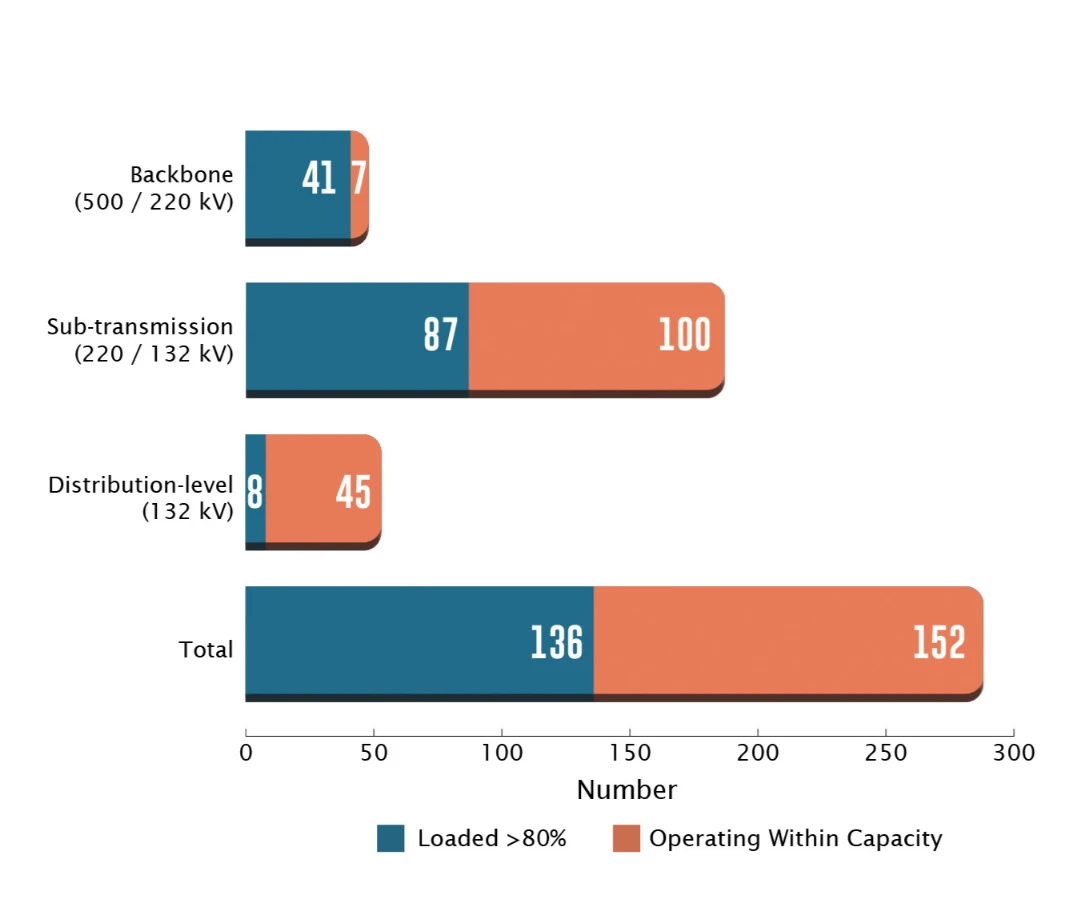
The operational layer of the grid is also behind where it needs to be. SCADA-III, the project intended to strengthen real-time grid visibility, was originally approved with a June 2022 completion target and has since been pushed to June 2026. That delay also affects EV planning because the system will have to manage more variable and localised demand than before.
Cars are getting cheaper faster than grids can grow
The history of technological transitions suggests that adoption rarely slows because the technology itself stops improving. Wright’s Law predicts that costs fall as production scales, creating a cycle in which cheaper technologies attract more users, which in turn drives further cost reductions. The constraint eventually shifts elsewhere. In China’s EV transition, falling vehicle costs were matched by investments in transmission networks, substations, and charging infrastructure. Pakistan faces a different risk as EVs may become cheaper, and adoption may accelerate, but electricity networks would not scale at the same pace as consumer technologies. A charger can be installed in weeks; expanding the infrastructure needed to reliably power thousands of chargers can take years.
Pakistan’s EV Bottleneck Is Already Showing Up in Voltage Data
Annual voltage violations, FY2024-25
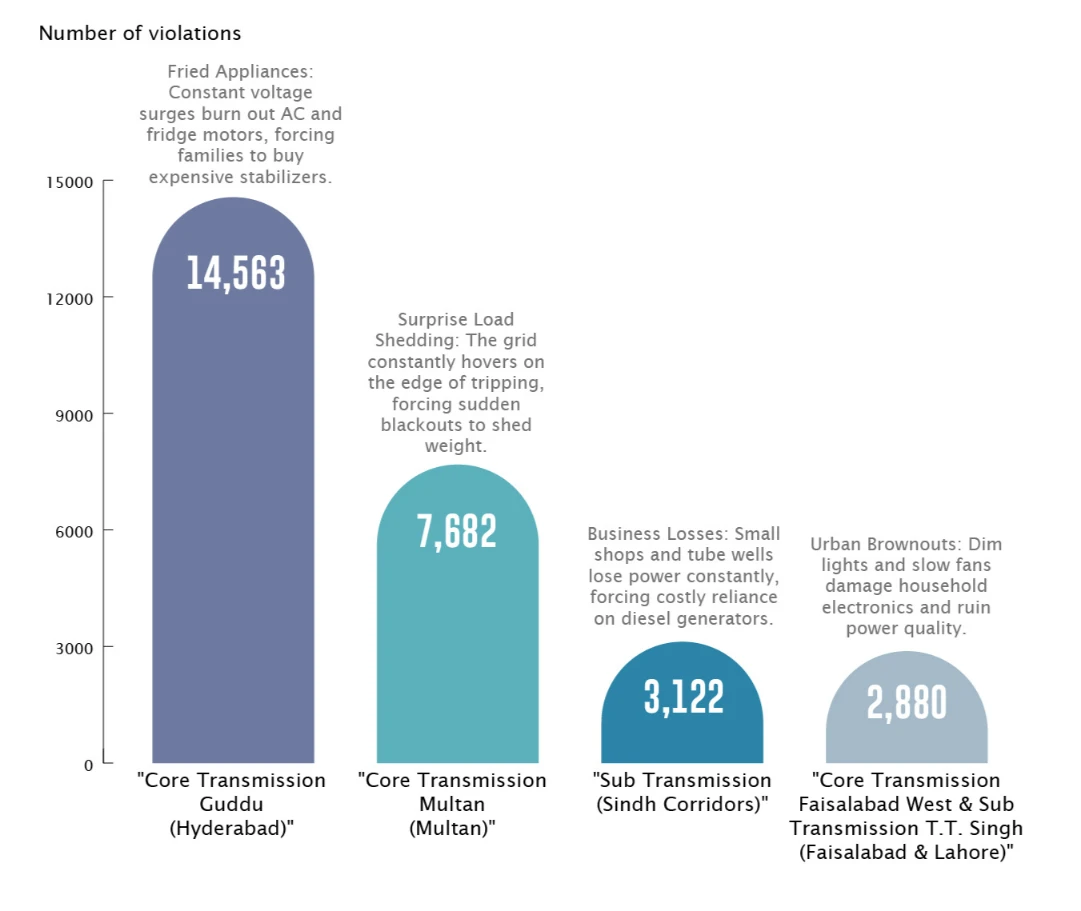
Pakistan still has time to sequence the transition correctly. EV policy should not begin with charger counts alone but instead with hosting-capacity maps for cities and highways, transformer-level load assessments, voltage-quality screening, and time-of-use charging rules that reflect actual grid conditions. Public chargers should be planned where the network can absorb new demand, not only where traffic is high or land is available. Home charging should be treated as a distribution-planning issue, not merely a consumer choice.
The primary challenge of Pakistan’s grid planning is no longer only about building more generation. It is about placing new demand where the network can carry it. If that discipline is missing, Pakistan may build an EV transition that looks credible in policy documents but fails at the point that matters most: the charging point.
References:
- NEPRA, Performance Evaluation Report of Transmission Licensees FY2024-25
- NEPRA, State of the Industry Report 2025
- Government of Pakistan, Draft New Energy Vehicle Policy 2025-30
- International Energy Agency, Global EV Outlook 2025
- Our World in Data, Learning Curves / Wright’s Law explainer
- NEECA, EV Charging Infrastructure and Battery Swapping Station Regulations 2024
- NEPRA, Performance Evaluation Report of Distribution Companies FY2024-25
- NTDC / NGC, Transmission System Expansion Plan 2024-34
- PIDE, Power-sector briefs on DISCO reform, circular debt and tariff design
- World Bank, Pakistan power-sector and transmission/distribution reports
- Asian Development Bank, Pakistan energy-sector and grid-modernisation reports
- Reuters, Pakistan EV market / BYD Pakistan reporting
NOTE:
This story was produced as part of the Climate-Smart E-Mobility Fellowship for Journalists 2026 by the Sustainable Development Policy Institute (SDPI). The fellowship offered a great opportunity to look beyond the headlines and examine Pakistan’s e-mobility transition through data, policy and the experiences of people affected by rising transport costs. We’re grateful to SDPI for investing in journalists and creating a space for deeper, more informed reporting on Pakistan’s energy and mobility challenges.